CDL School Marketing
How to Market a CDL School: Student Recruitment & Enrollment
A practical CDL school marketing guide for private truck-driving schools. Learn how SEO, Google Maps, websites, lead follow-up, tours and enrollment systems work together to fill more class starts.
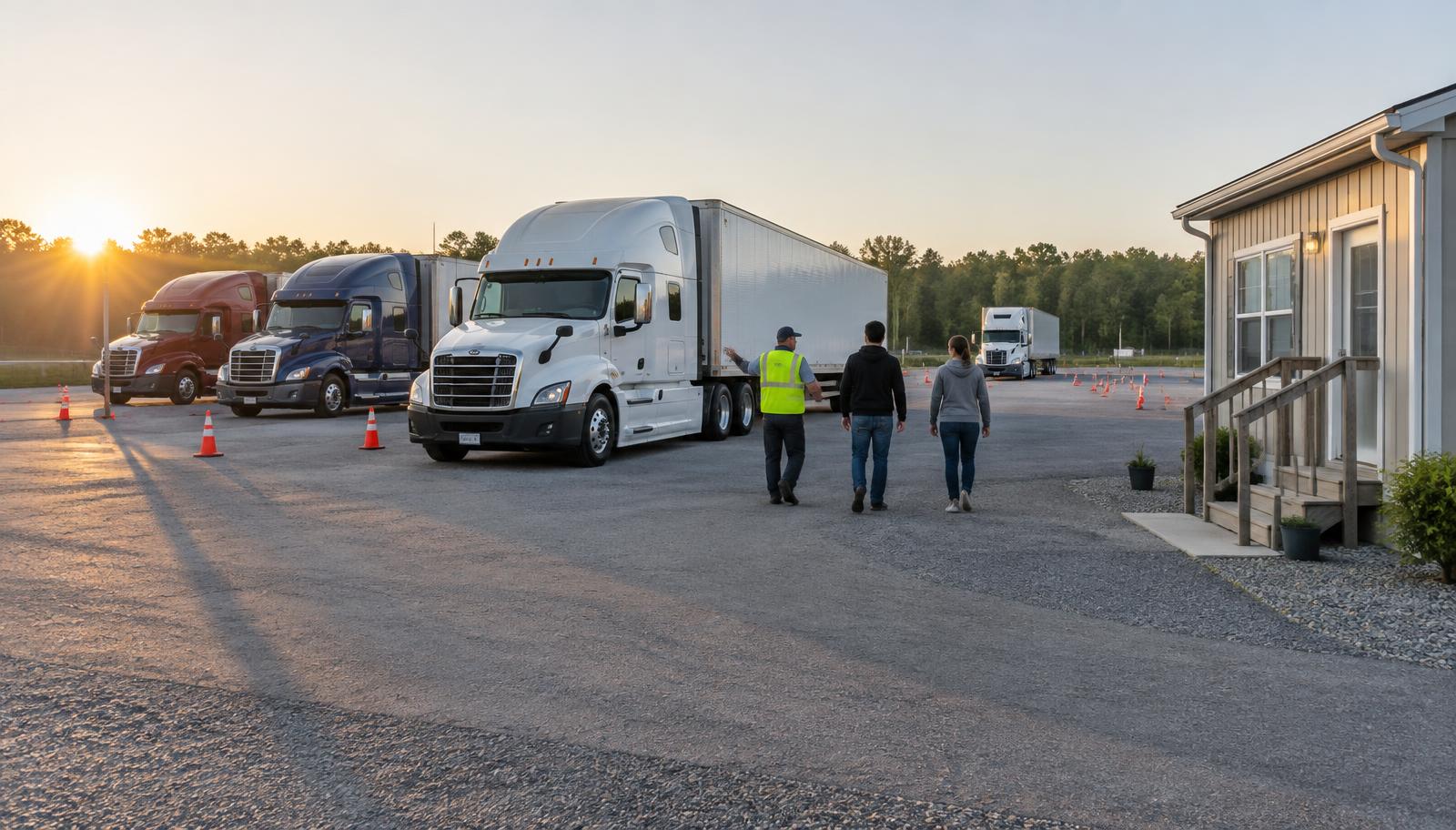
The Private CDL School Growth System
Getting more CDL students is not just an advertising problem. Most trade school marketing advice stops at lead generation, but private CDL schools have a more complicated enrollment path involving permits, funding, schedules, admissions requirements and fixed class starts.
Private schools have to get found, earn trust, respond quickly, answer real enrollment questions, move prospects through admissions and keep committed students moving toward Day One.
This guide breaks down the entire system.
A private CDL school has a finite number of seats. Every class start has a fixed number of trucks, instructors and range hours behind it. That is the number marketing should ultimately be measured against.
Clicks are not enough. Leads are not enough. Applications are not enough. The useful number is simple: how many qualified prospects become actual class starts?
At Truck School Marketing we have spent the past several months studying how that number gets made — public CDL-school enrollment paths, the questions prospective students ask, school websites, Google visibility, admissions processes and pre-start systems. The Growth Center research includes repeated directional audits of private CDL schools, usually eight to ten schools at a time.
Those samples are small on purpose. They are not national statistics. They are a working look at what a prospect actually encounters when they try to choose a school — and where schools quietly lose students along the way.
Most schools do not have one “lead generation problem.” Enrollment is a connected system. A school can rank well and still lose students because the website doesn’t answer the right questions. It can generate leads and lose them to slow response. It can book tours and lose them to unstructured follow-up. A student can even enroll and never reach Day One.
Central framework
The CDL School Growth Framework
Select a stage to see the question an owner should be able to answer about it.
CDL School Marketing Is Different From Ordinary Lead Generation
Most lead-generation and general trade school marketing advice is written for low-consideration purchases. CDL training is the opposite. It is a career change, often for a working adult, with tuition or funding questions, state licensing requirements, a permit to obtain, a DOT medical exam to pass, family and work obligations to rearrange, and a fixed class schedule to fit into.
On the school side, capacity is finite too. You can’t add a seat to a class that has no truck for it.
So the real decision a prospect is working through usually sounds like this:
- “Can I afford this?”
- “Can I attend this?”
- “Can I actually get through admissions?”
- “Will employers hire me afterward?”
- “When can I start?”
“Start Your New Career” doesn’t answer any of those. Marketing that works for a CDL school has to answer them — on the page, on the phone and during the tour.
1. Own Local Search Before You Buy More Traffic
CDL training is local. A prospect needs a campus they can drive to several times a week, so most serious searches carry a city, a “near me” or a Maps view. That puts Google Search, Google Maps and your Google Business Profile at the very top of the funnel.
Owning local search means a few unglamorous things done consistently: accurate business information, real photos of the yard and equipment, current reviews, clear directions, a dedicated page or section for each campus and program, and organic content that answers what people actually search before they call.
In October 2026 we reviewed the local trust signals a prospect would encounter across eight private CDL-school search paths.
Original research
What 8 CDL School Search Paths Showed Before First Contact
The lesson isn’t “every school needs an address.” Every school in the sample had one. The lesson is that the basics are table stakes, and the separation happens in the proof layer: reviews, location-specific content and evidence that the yard and the trucks are real.
A prospective student evaluating a CDL school wants to know the campus, equipment and operation exist before they contact admissions. If the search result can’t show that, the prospect clicks the next listing.
Buying paid traffic on top of a weak local presence usually means paying to send people to the same unanswered questions. If you want the deeper breakdown of rankings, Maps and program pages, see our Google visibility and SEO work for CDL schools, and for how regulatory changes are reshaping local competition, read The CDL School Shakeout.
2. Your Website Should Answer the Questions That Cost You Leads
A CDL school website’s job is not to collect contact information. Its job is to remove the biggest enrollment uncertainties so the right prospects feel confident enough to reach out.
Across our research library, the topics prospects repeatedly evaluate are consistent: tuition, funding options, class start dates, day/night/weekend schedules, permit timing, admission requirements, driving-record concerns, the DOT physical, drug-screen policy where applicable, training hours, actual behind-the-wheel time, automatic vs. manual, instructor credibility, truck access and what happens after a failed test.
Website checklist
Before You Ask for the Lead
01What the program is
02What it costs / how payment works
03When training happens
04What the student needs
05What training actually looks like
06What happens next
That doesn’t mean every school must publish every exact number. Plenty of schools have good reasons to discuss final tuition or funding on a call. But withholding basic decision information has a cost: the prospect either shops elsewhere or submits three competing forms and talks to whoever explains it first.
We’ve covered the individual pieces in depth:
- Training transparency — what to show about hours, equipment and behind-the-wheel time.
- The admissions checklist — what to explain and collect before Day One.
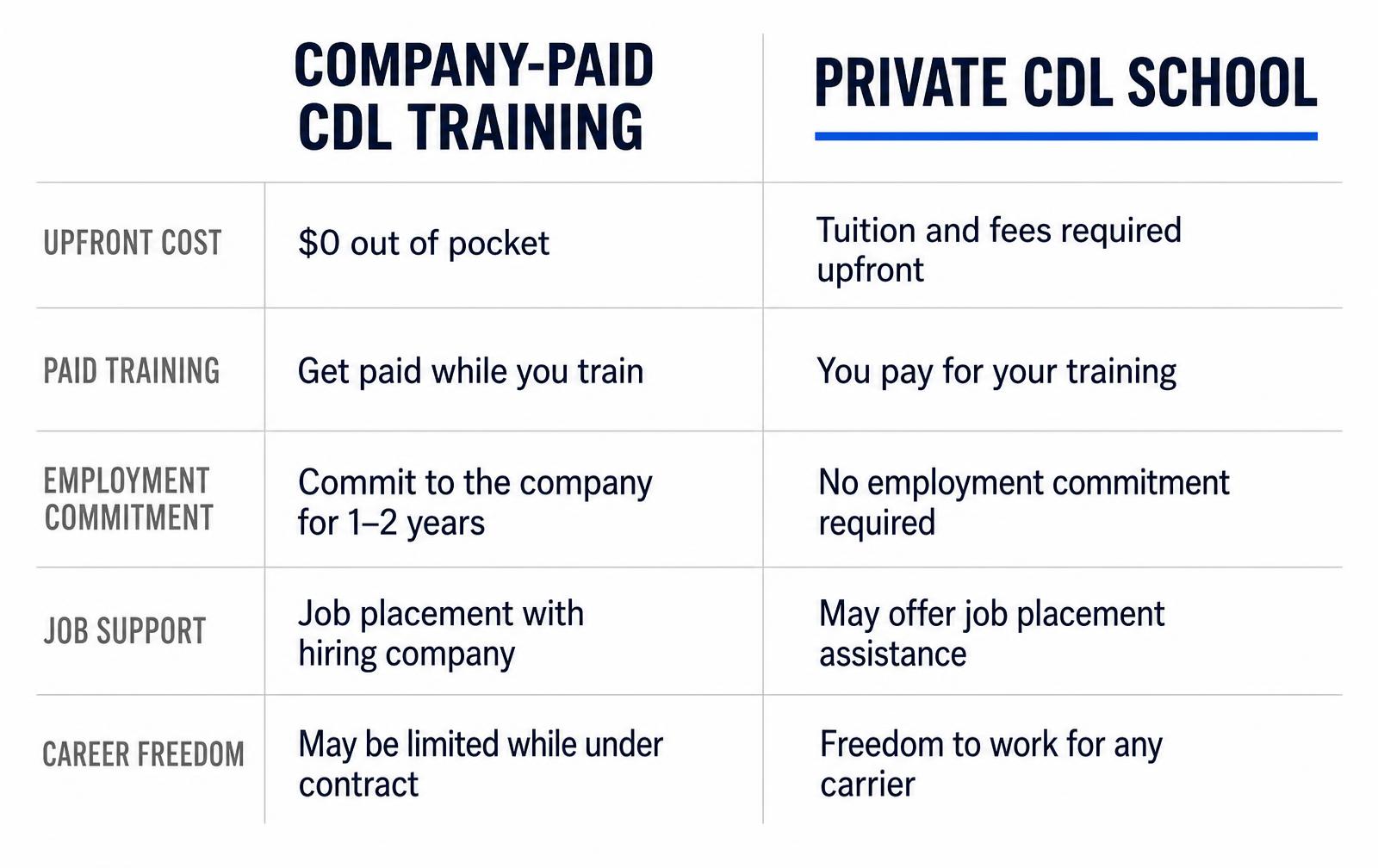
- Company-paid vs. private CDL training — how to answer the “why pay you?” question honestly.
- Automatic vs. manual training — the E restriction question prospects ask more than schools expect.
If the site itself is the bottleneck, our CDL school website work is built around exactly these questions.
3. Make It Ridiculously Easy to Start a Conversation
Once a prospect is interested, the next job is simple to describe and surprisingly uneven in practice: make the first conversation easy, and make it clear what happens after they reach out.
In September 2026 we walked ten public CDL-school enrollment paths the way a prospect would.
Original research
What 10 CDL School Enrollment Paths Make Easy to Do
Original Research
Read alongside the eight-path local review above. Both are small, directional samples meant to show patterns, not to rank schools.
Most schools make it possible to contact them. Far fewer set expectations about how and when the conversation continues. Many prospects are working full time; a phone number with no hours, no text option and no idea when anyone will call back is a reason to try the next school.
That gap is a conversion opportunity, and it’s one of the cheapest to close.
4. Speed-to-Lead Matters — But Context Matters More
Fast response matters. A prospect who just submitted a form is thinking about your school right now; an hour later they may be on the phone with someone else.
But speed alone isn’t a follow-up strategy. “Hi, are you still interested in CDL school?” is fast and weak. It ignores everything the prospect already told you.
Follow-Up Should Match the Barrier
What you know
Next conversation
Price question
→ Tuition and funding conversation
WIOA
→ Funding-status follow-up
Working full time
→ Evening / weekend schedule
No permit
→ Permit-readiness path
MVR concern
→ Admissions review
Tour completed
→ Enrollment next step
Enrolled
→ Stop marketing; start readiness coordination
A “cold lead” is often just a prospect with an unresolved question. Stage-aware follow-up — missed-call text-back, reminders and messages tied to where the student actually is — is what our recruiting and automation work is built to support.
5. The School Tour Is a Sales Event
For most private CDL schools, the tour is where trust is won or lost. It’s also the step most schools measure least.
A good tour isn’t a pitch. It’s a chance for the prospect to verify what the website promised:
- The campus is real.
- The equipment is real.
- The instructors are credible.
- The training environment looks organized.
- The schedule makes sense.
- The admissions process is clear.
- The student understands what happens after enrollment.
Aggressive closing tends to backfire with career changers who are already nervous about the decision. The tour should reduce uncertainty, and then the next step should be obvious.
Track it like any other stage: inquiry → tour booked, tour booked → tour showed, tour showed → application, application → enrollment. A booked tour is not an enrollment.
6. Enrollment Does Not End When the Student Says Yes
An enrollment is not a class start. Between the signature and Day One, students fall out for reasons that have nothing to do with marketing: a permit delay, a medical issue, drug-screen timing where applicable, missing documents, a funding authorization that hasn’t cleared, a work conflict, childcare, transportation or simple confusion about the start date.
We cover this gap in detail in The Student Said Yes. Then They Never Made It to Class. The short version is that readiness needs its own pipeline.
Process graphic
The Ready-to-Start Pipeline
Step 1 of 9: Seat Reserved
The student has a specific class start, not just an intention to enroll.
The CRM should know whether a student is READY, not merely whether the student is ENROLLED.
7. Measure the Funnel That Actually Fills Your Class
Cost per lead can look great while class starts stay flat. If the cheap leads never get contacted, never tour or never start, the low number is hiding the problem rather than measuring success.
An owner needs to know where the funnel leaks. That takes a short scorecard, reviewed on a regular cadence.
Owner scorecard
- Leads
- How many inquiries arrived, and from which source?
- Contact rate
- What share reached a real conversation?
- Tours booked
- How many conversations became an appointment or tour?
- Tour show rate
- How many booked tours actually happened?
- Application rate
- How many completed tours led to an application?
- Enrollment rate
- How many applications became enrollments?
- Enrolled-to-start rate
- How many enrolled students started class?
- No-show rate
- How many tours and start dates were missed?
- Cost per lead
- Useful, but only alongside the rows below.
- Cost per enrollment
- What it costs to get a signed student.
- Cost per class start
- The number that best reflects marketing spend against filled seats.
Interactive tool
CDL Enrollment Funnel Calculator
Enter your own numbers. Each rate applies to the stage before it. Nothing is saved or sent anywhere.
- Contacts
- 60
- Tours booked
- 24
- Tours completed
- 17
- Enrollments
- 8.4
- Estimated class starts
- 6.7
If you improve one stage by 10%
- Contact rate 60% → 66%+0.7 starts
- Tour / appointment booking rate 40% → 44%+0.7 starts
- Tour show rate 70% → 77%+0.7 starts
- Enrollment rate (of completed tours) 50% → 55%+0.7 starts
- Enrolled-to-start rate 80% → 88%+0.7 starts
Straight multiplication of your inputs, per month. A 10% relative improvement at any single stage raises estimated starts by about 10%; the useful question is which stage is cheapest for your school to improve.
8. More Leads Are Not Always the Answer
More leads will not fix a broken enrollment process. Before increasing spend, find the stage where students are falling out. The numbers usually point to it.
Diagnostic matrix
Where Is the Funnel Actually Breaking?
If
Traffic is low
→ Visibility problem
Google Maps presence, location pages, reviews and organic content.
If
Google visibility is strong but inquiries are low
→ Website / trust problem
Program clarity, cost and schedule context, training proof, mobile experience.
If
Inquiries are high but conversations are low
→ Response problem
Response time, missed calls, texting, after-hours handling.
If
Conversations are high but tours are low
→ Qualification / offer problem
Lead fit, schedule match, funding questions, how the tour is offered.
If
Tours are high but enrollments are low
→ Admissions / trust / price problem
Tour experience, admissions clarity, pricing and funding conversation.
If
Enrollments are high but starts are low
→ Readiness / onboarding problem
Permit, medical, documents, funding authorization and pre-start confirmations.
What a Good CDL School Marketing System Looks Like
Use this as a quick audit of your own school. Gaps in any one group tend to show up as a leak in the diagnostic matrix above.
The Owner Checklist
01Visibility
- Google Maps
- Organic search
- Local pages
- Reviews
02Website
- Program clarity
- Pricing / funding context
- Schedules
- Admissions
- Training proof
- Strong mobile UX
03Conversion
- Phone
- Text
- Forms
- Appointments
- Fast response
04Enrollment
- Tours
- Application
- Funding
- Documents
- Permit
- Start date
05Automation
- Missed-call follow-up
- Stage-specific messages
- Appointment reminders
- Pre-start readiness
- No-show recovery
06Measurement
- Lead source
- Lead-to-contact
- Tour rate
- Enrollment rate
- Start rate
- Cost per start
Want to See Where Your Enrollment Funnel Is Leaking?
Truck School Marketing works specifically with private CDL schools on websites, local visibility, student recruiting and enrollment systems.