Student Search Behavior
What Prospective CDL Students Want to Know About Wheel Time, Class Size, Training Access and Retesting
Prospective students see program hours, class lengths and “hands-on training” claims everywhere. What many still cannot tell is how much they will actually drive, how training access works, or what happens if they need more time.
Original Research
Includes a September 2026 review of 10 private CDL school websites.
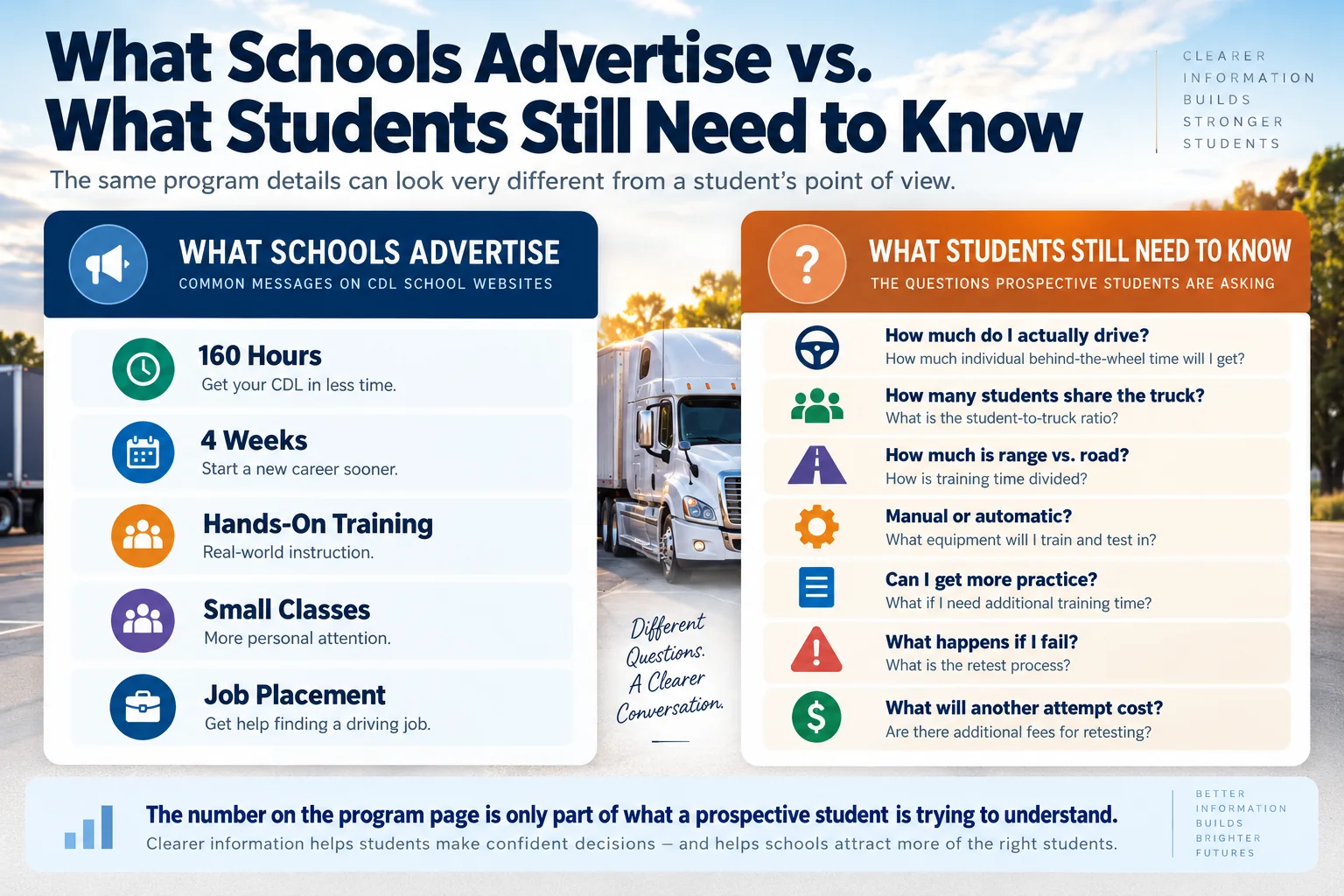
A CDL school can honestly advertise a 160-hour program and still leave a prospective student with no idea how much time they will actually spend driving a truck.
That distinction matters.
Someone looking at CDL school is often preparing to spend thousands of dollars, rearrange work, figure out childcare and commit several weeks of their life to training.
Eventually, the questions get more specific:
- How much will I actually drive?
- How many students are sharing the truck?
- How much time is on the range versus the road?
- What if I need more practice?
- What happens if I fail the skills test?
Those aren’t negative questions. They’re buying questions.
After reviewing current student discussions, federal training requirements and the websites of 10 private CDL schools, one thing became clear: most schools do a better job explaining how long training lasts than explaining what the student actually gets access to during that training.
A 160-Hour Program Does Not Mean 160 Hours of Individual Driving
Federal Entry-Level Driver Training rules do not require a minimum number of behind-the-wheel hours for the applicable Class A, Class B, passenger or school-bus curricula.
Instead, FMCSA requires the instructor to determine that the trainee has demonstrated proficiency in the required behind-the-wheel skills on the range and public road.
Theory works similarly. There is no federal minimum theory-hour requirement, although providers must cover the required curriculum and students must achieve at least an 80% overall score on the theory assessment.
So when a school advertises “160 hours of training,” that number doesn’t automatically tell a prospect:
- how much is classroom
- how much is range
- how much is public-road training
- how much is observation
- how much time the student personally operates the truck
That’s not an argument against 160-hour programs. It’s an argument for explaining what the 160 hours mean at your school.
One current example is 160 Driving Academy. Its website describes a 160-hour program consisting of 40 classroom hours and 120 hours behind the wheel, while also clarifying that the 120-hour block includes both active driving and observation.
That’s useful information.
The lesson isn’t that observation is bad. Students can learn by watching someone else work through a maneuver.
The lesson is that “behind the wheel” may mean something different to the school than it means to the prospect reading the page. Define it.
This is one reason strong CDL school program pages need to do more than list a course length and a contact form.
What Can Sit Inside a CDL Training Program?
Total program hours can include several different types of instruction.
Total Program Hours
Stage 1
Theory
Classroom or online instruction covering required knowledge and theory topics.
Stage 2
Range
Vehicle control, backing, inspection and required range maneuvers.
Stage 3
Public Road
Real-world driving practice in traffic and public-road conditions.
Stage 4
Observation / Other Structured Training
Observation, instructor coaching and other structured program time where applicable.
Total program hours do not automatically equal individual driving hours.
Training structure, equipment access and driving rotations vary by school.
Wheel Time Is Really a Training-Access Question
Students talk about “wheel time,” but what they’re really trying to understand is access.
- How many trucks are available?
- How many students rotate through each truck?
- How many instructors are working with the group?
- What happens during road training?
A school advertising “small class sizes” still hasn’t necessarily answered any of those questions.
Six students sharing one truck could have less individual access than 12 students working across several trucks with multiple instructors.
A few schools we reviewed make this much easier to understand.
- SAGE says its road training uses one student per truck with an instructor and says most road-driving sessions are around four hours.
- Truck Driving Schools of America publishes four students per truck, along with 20–30 actual behind-the-wheel hours.
- Big Rig Truck Driving School says students receive at least 40 hours of actual behind-the-wheel instruction and openly states that overall instructional time can vary based on class size.
Those are useful claims because a prospective student can picture the training experience.
Compare:
Small classes and hands-on CDL training.
with:
Four students per truck. Students rotate through range and road training and receive approximately 20–30 hours of actual driving time.
The second one answers a buying question.
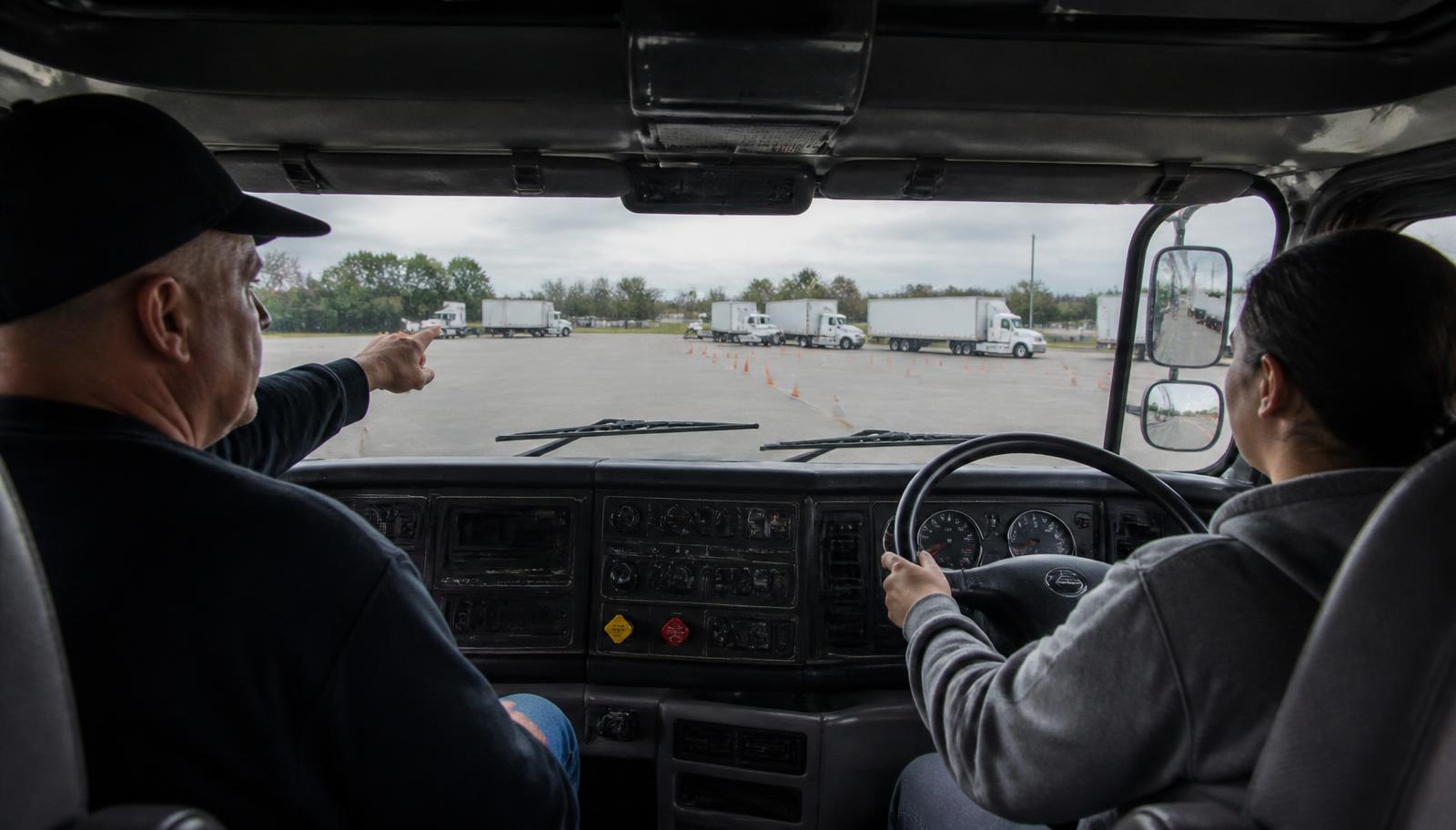
Range Time and Road Time Aren’t the Same Thing
The phrase “hands-on training” gets used constantly on CDL school websites. It doesn’t tell a student very much.
Range training and public-road training develop different parts of the student’s skill set, and federal ELDT requirements distinguish between the two.
A better program page can simply show the progression:
Theory → Range → Public Road → Readiness Check → Skills Test
Explain what happens during each stage. For example:
- Range training: pre-trip, basic controls, backing and required maneuvers.
- Road training: intersections, turns, shifting where applicable, lane positioning, traffic awareness and real-world vehicle control.
You don’t need three paragraphs of marketing copy. The student needs to understand what happens.
These are also the kinds of specific questions that shape how prospective CDL students search before choosing a school.
Manual vs. Automatic Should Be Explained Before Enrollment
This is another area where the actual equipment matters.
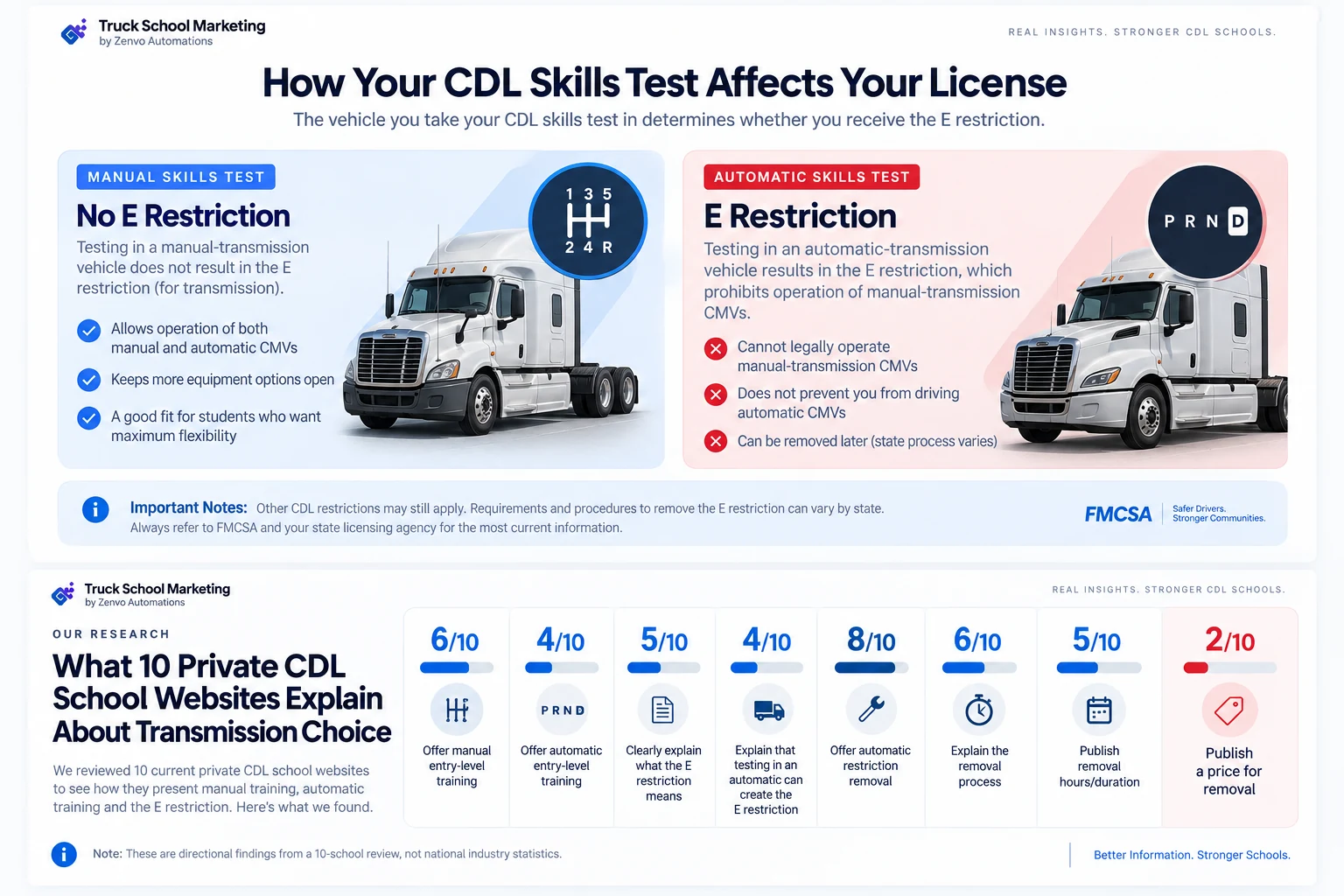
If students train or test in an automatic vehicle, there can be consequences for the CDL they receive, including the E restriction that prevents operation of a manual-transmission commercial vehicle.
Schools offering both options should explain:
- what equipment students normally train in
- what vehicle they are likely to test in
- what restriction may result from testing in an automatic
- whether manual training is available
- whether restriction-removal training is available later
Our 10-school review found that six clearly explained manual versus automatic training, while four clearly explained the manual-transmission restriction.
This shouldn’t be something a student figures out halfway through class. Put it on the program page.
From FMCSA
New Training Requirements for Entry-Level CDL Drivers
A short federal overview of Entry-Level Driver Training requirements and the Training Provider Registry.
Watch the 4-minute FMCSA overview →The Question Schools Avoid: “What If I Need More Practice?”
This may be one of the most useful questions an admissions team can answer.
Not everyone progresses at the same pace.
One student may pick up backing quickly and struggle with shifting.
Another may be comfortable driving on the road but freeze during the test. Another may simply need more repetitions.
Recent student discussions we reviewed repeatedly came back to the same concern: what happens if the normal schedule isn’t enough for me?
The answer doesn’t have to be “unlimited free training.” Schools have businesses to run. Extra practice might be:
- included under certain conditions
- instructor-approved
- scheduled when equipment is available
- billed hourly
- offered as a refresher program
- provided specifically before a retest
All of those can be legitimate policies. What creates frustration is not knowing the policy exists until the student is already struggling.
If extra practice costs money, publish the price. If additional time is included, say what’s included. If it’s handled case by case, explain the process.
Specific beats vague.
The same questions should also be built into your student recruiting and follow-up process, so prospects do not have to restart the conversation every time they speak with someone new.
Truck School Marketing Research
What 10 Private CDL School Websites Explained Before Enrollment
In September 2026, Truck School Marketing reviewed 10 current private CDL-school websites using the same disclosure criteria. This is a small directional website audit — not a national industry survey — but the gaps were consistent enough to be useful.
- Program hours9/10
- Range vs. public road9/10
- Theory/practical split6/10
- Manual vs. automatic6/10
- Additional/remedial practice4/10
- Individual driving-time expectations3/10
- Student/truck or instructor access2/10
- Retest pricing or included attempts2/10
- Complete failed-test policy0/10
- Complete post-failure process0/10
- 9/10
- Clearly stated program hours
- 3/10
- Clearly explained individual driving-time expectations
- 0/10
- Clearly explained the complete post-failure process
Directional review of 10 private CDL-school websites conducted September 3, 2026. Results should not be interpreted as national industry percentages.
Failed-Test Support May Be the Biggest Website Blind Spot
Schools are very comfortable telling prospects what happens if everything goes according to plan. They are much less likely to explain what happens when it doesn’t.
That’s backwards.
A prospect should be able to understand:
- Who administers the CDL skills test?
- Is the first attempt included?
- What happens immediately after a failed attempt?
- Is additional practice available?
- Is a school truck available for the retest?
- Are there additional school or equipment fees?
- Who schedules the next attempt?
- Do state waiting periods or attempt limits apply?
State CDL retesting rules vary, so this information often needs to be location-specific rather than copied across a national website.
The school doesn’t have to turn its website into a state CDL manual. Explain your part of the process and link students to the appropriate state source where necessary.
What Happens After the CDL Skills Test
Pass
- Licensing / Next Step
Did Not Pass
- Review Result
- Additional Practice if Needed
- Schedule Next Eligible Test
- Retest
Waiting periods, attempt limits and fees vary by state. School policies can vary separately.
“Job-Ready” Needs a Definition Too
A graduate who passes the CDL skills test is still an entry-level commercial driver.
That is not the same thing as an experienced driver who has spent years backing into docks, dealing with traffic, running mountain grades and handling bad weather.
That doesn’t diminish the value of CDL school. It simply means phrases such as “job-ready” should be used carefully.
Does your school mean:
- ready to complete the CDL licensing process?
- ready to pursue entry-level driving jobs?
- ready to enter a carrier’s orientation and finishing program?
Say what you mean.
Students are already having these conversations online. If the school doesn’t set the expectation, somebody else will.
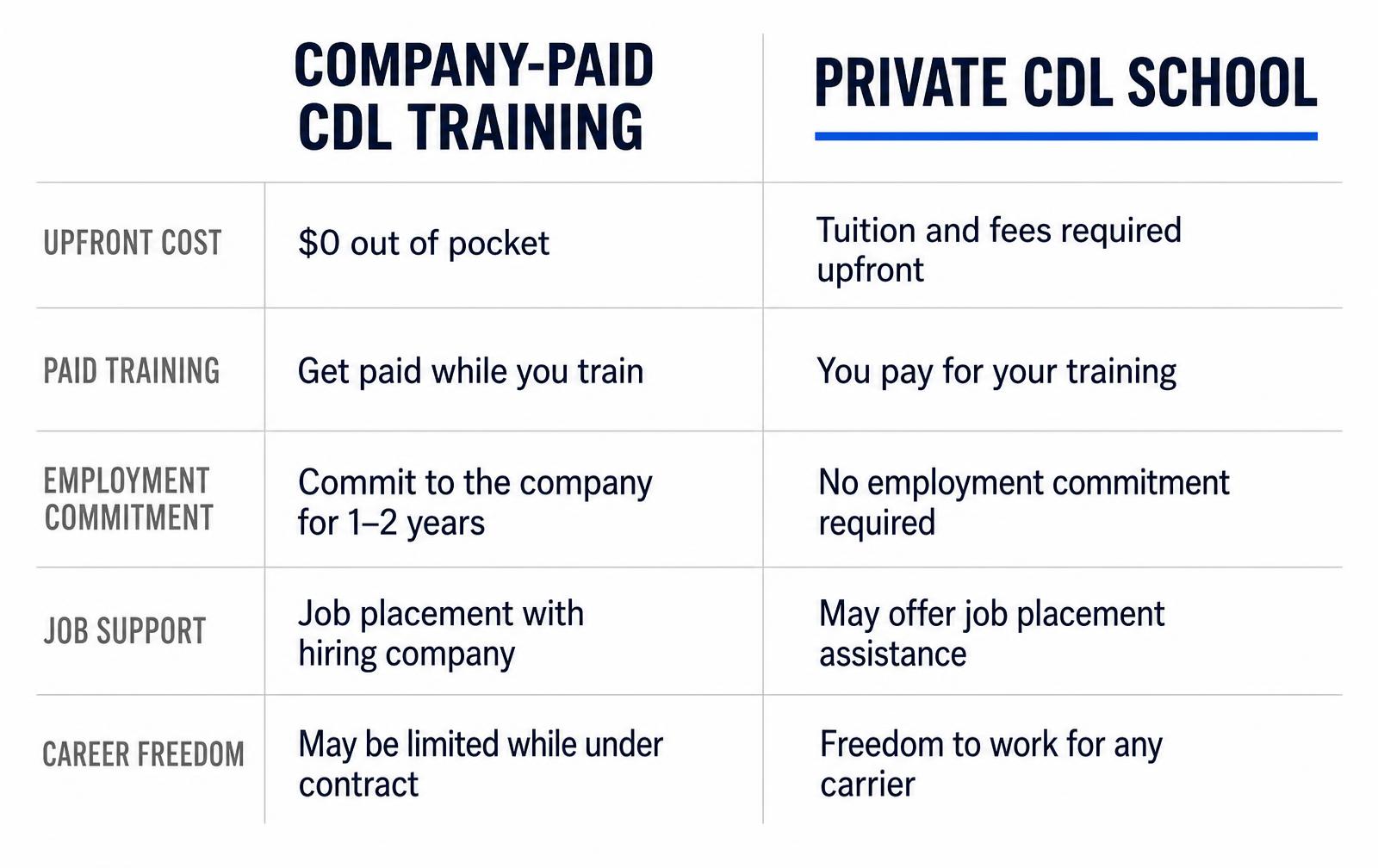
Employment expectations also show up when students compare a private school with company-paid CDL training, where the training and employment path may be packaged together very differently.
What a High-Transparency CDL Program Page Should Explain
You don’t need a 5,000-word program page. You need a useful one.
- Total program hours and duration
- Theory/classroom structure
- Range training
- Public-road training
- How driving rotations work
- Truck and instructor access
- Manual vs. automatic equipment
- Relevant license restrictions
- Testing process
- Additional-practice options
- What happens if the student isn’t test-ready
- What happens after a failed skills test
- School-controlled practice/retest/equipment fees
- What job-placement assistance actually includes
- Next available class dates
The goal isn’t to put every admissions conversation on the website. It’s to make the conversation better.
See how we approach CDL school website structure and program-page content.
Transparency is one piece of a larger student recruitment and enrollment strategy.
Transparency Isn’t About Making Your Program Look Perfect
Owners sometimes worry that publishing a four-students-per-truck ratio might look worse than simply saying “small classes.”
They worry that telling students about retest fees will scare them away.
They don’t want to talk about students failing before the person has even enrolled.
But serious prospects already know they might struggle. They already know CDL school costs real money. They already know the test isn’t guaranteed.
The questions that sometimes sound negative to an admissions team are often exactly what a responsible student should be asking.
- How much do I actually drive?
- What if I need more practice?
- What if I don’t pass the first time?
A school that can answer those questions clearly doesn’t look weak. It looks like it knows how its program works.
And in a market where almost every school can say hands-on training, experienced instructors and job placement assistance, operational clarity can become a real differentiator.
The Takeaway
Don’t just tell students how many hours your program has.
Help them understand what happens during those hours.
Sources and Further Reading
FMCSA
Part 380 Appendix — Entry-Level Driver Training guidance Q&AFMCSA Training Provider Registry
Training requirements for entry-level CDL applicantsFMCSA Training Provider Registry
Registered training provider searchSAGE Truck Driving Schools
Why one-on-one CDL training works bestTruck Driving Schools of America
Program structure, student-to-truck ratio and driving hoursBig Rig Truck Driving School
Class A CDL course details160 Driving Academy
Program FAQ — classroom and behind-the-wheel hoursCNS Trains
CDL training pricing and program information
School program details change. Readers should verify current hours, equipment, fees and testing policies directly with each provider, and confirm CDL testing rules with the appropriate state agency.