Student Search Behavior
Company-Paid CDL Training vs. Private CDL School: What Prospective Students Are Really Comparing
Students aren't simply comparing CDL school tuition. They're comparing income, job certainty, employment commitments, flexibility, and how clearly they can see the path from training to a paycheck.
Most Prospective Students Have Heard About Company-Paid CDL Training. Far Fewer Understand How It Works.
A prospective student usually doesn’t call a CDL school after spending three nights comparing carrier contracts, tuition reimbursement programs, training pay and employment commitments.
It’s normally much simpler. They’ve heard that a trucking company will pay for their CDL training.
Maybe a friend told them. Maybe they saw an ad. Maybe they watched a video telling them: “Don’t pay for CDL school. Get a company to pay for it.”
So eventually the private CDL school gets the question: “Why would I pay thousands of dollars for CDL school if a trucking company will train me?”
It’s a fair question. And after years of talking with prospective CDL students, I’ve found that there is usually a big difference between knowing company-paid CDL training exists and understanding how a specific program actually works.
Most prospects know the headline: get your CDL without paying thousands upfront. They may not know about the employment agreement. They may not know what happens if they leave early.
They may not know where training takes place, how much they’ll earn while training, how long they’ll be away from home, what type of driving job follows training, or how much flexibility they’ll have if that first company isn’t a good fit.
And the terms aren’t the same everywhere. Some carrier programs structure the commitment around a specific period of employment. Others use mileage requirements, repayment agreements, reimbursement schedules, or other conditions.
That’s why, when company-paid training comes up on an enrollment call, one of the worst things a private CDL school can do is immediately start attacking it.
I usually slow the conversation down. Not because company-sponsored CDL training is bad. For the right student, it can be a very good way into trucking. The question is whether the student understands what they’re choosing and what they’re giving up in exchange.
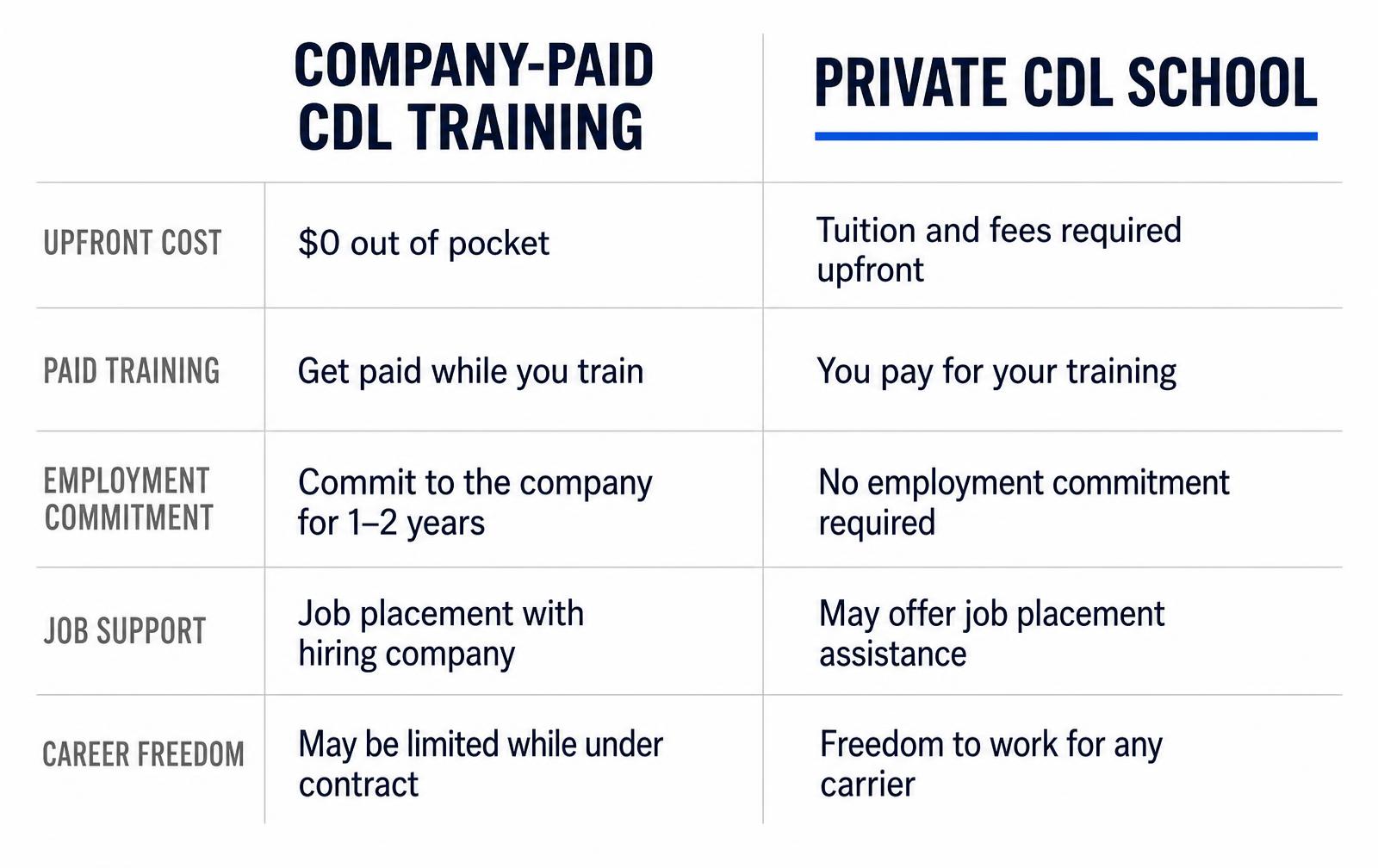
Most prospects have heard about paid CDL training. Far fewer understand what they are actually agreeing to.
“Free” Is Only One Part of the CDL Training Decision
The research we’ve been collecting around prospective CDL students keeps showing the same pattern. Students aren’t only asking what CDL school costs. They’re trying to reduce the risk of making the wrong decision before they commit their money, time and career to it.
Questions about employment after graduation, funding, schedules, company-paid training, automatic restrictions and job placement keep appearing together because they’re all part of the same decision.
A student may really be asking:
- Can I afford training?
- Can I keep earning money while I train?
- Will someone hire me when I’m finished?
- Can I stay local?
- Am I committing myself to one employer?
- What happens if that first job doesn’t work out?
- Could an employer reimburse my private-school tuition anyway?
That last question is especially important. The choice is not always “pay for CDL school yourself” or “have a trucking company pay for everything.” There is a middle ground.
Some trucking companies operate their own paid training programs while also offering tuition reimbursement to qualified drivers who attended an independent CDL school. That means a private CDL school can still be part of an employer-funded path even when the employer did not provide the original CDL training.
That’s something many prospective students don’t know. And it is something private CDL schools should explain much better.
The Real Competition Is Certainty
A private CDL school may think it’s competing against a zero-dollar tuition offer. That’s only part of it. It’s competing against perceived certainty.
Many carrier programs don’t simply sell training. They show a progression:
Apply → Train → Earn the CDL → Continue Training → Start Driving
The student can see what happens next. That matters because somebody considering CDL training may also be thinking about rent, childcare, their current job, time away from home, and how quickly they can start earning again. When the path is clear, it feels safer.
When a private-school website says:
- 160-Hour Class A CDL Program
- Experienced Instructors
- Modern Equipment
- Job Placement Assistance
…the school may be providing excellent training, but it is leaving the prospect to answer one of the biggest questions alone: “What happens to me after graduation?”
And that is where a lot of the perceived advantage of company-paid CDL training begins. Fixing it is usually a CDL school website problem before it is a sales problem.
Private CDL School Does Not Mean “You’re on Your Own”
This is where the conversation around independent CDL schools often becomes too simplistic. I work directly in CDL school enrollment, and employer recruiting is part of what I see in the real world.
Companies don’t simply wait until students graduate. Major carriers come into schools and talk directly with students. At our school, companies such as TMC, Schneider and Werner have done job presentations.
Smaller trucking companies recruit too. So do local operations, waste companies and employers whose CDL jobs look very different from the traditional long-haul path many prospects picture when they first think about trucking.
That matters. An independent CDL student may have the opportunity to hear from multiple employers and multiple types of driving jobs before graduation.
The school cannot — and should not — guarantee employment. But that’s very different from telling someone: “Pay your tuition, get your CDL, and then you’re on your own.”
A strong private CDL school should explain exactly what its employment support looks like. Not just “Job Placement Assistance,” but:
- Who visits the school.
- Whether students complete pre-hire applications.
- How the school connects graduates with employers.
- Whether employers offer tuition reimbursement.
- What kinds of local, regional and OTR jobs may be available to new drivers.
- And what help continues after graduation.
That’s the information a prospective student is actually trying to get.
The Five Things Prospective CDL Students Are Actually Comparing
1. Upfront Cost
The underlying question is “can I start at all?” Carrier-sponsored programs answer it by removing most or all of the upfront tuition, usually in exchange for terms after training.
An independent school may answer it with financing, workforce or veterans funding, employer sponsorship, or reimbursement after hire. Those options only help if the website names them plainly, with who qualifies and what the next step is.
2. Income While Training
Adults with bills rarely can stop earning for several weeks. Some carrier programs pay trainees during part of the process.
An independent school competes here on schedule and duration: whether a student can keep a current job, how many weeks training runs, and how many hours per week it takes. If your program supports working adults, that belongs above the fold, not on a PDF.
3. Employment After Graduation
The prospect wants to know that a job exists on the other side. A sponsoring carrier answers that by being the employer.
An independent school answers it with employer relationships: which companies recruit on campus, whether pre-hire letters happen before graduation, and what job types graduates typically move into. Name them.
4. Commitment and Career Freedom
This is the part prospects understand least. Company-paid training commonly comes with an employment, mileage or repayment agreement, and the specific terms vary by carrier.
Independent training generally leaves the graduate free to choose an employer. That is a real difference worth explaining calmly — without characterizing any specific carrier program you haven’t read.
5. Time From Training to a Paycheck
Everything above collapses into one question: how many weeks until money comes in? A carrier program tends to present that timeline as a single sequence.
Most private CDL school websites never show a timeline at all. Enrollment date, training length, testing, and the point where employer conversations start is a sequence you can publish today.
Why Carrier-Sponsored CDL Training Often Feels Easier to Understand
Carrier recruiting pages are built by recruiting teams. They tend to state one path, one next step, and one application form. Whatever else is true about the terms, the story is legible in about thirty seconds.
Independent school websites are more often organized around the school — programs, equipment, history, accreditation — instead of around the decision the prospect is making. That’s a structure problem, and it’s fixable.
How the Two Training Paths Can Look to a Prospective Student
| What the student is comparing | Company-paid CDL training may offer | Independent CDL school may offer |
|---|---|---|
| Upfront cost | Low or no upfront tuition | Self-pay, financing, workforce funding, employer sponsorship or reimbursement depending on the school and student |
| Income during training | Some programs pay trainees | Depends on the school schedule and student's employment situation |
| First employer | Usually connected directly to the sponsoring company | Opportunity to consider multiple employers |
| Commitment | May include employment, mileage or repayment terms | Usually no sponsoring-carrier employment obligation |
| Schedule | Typically follows the employer training schedule | Some schools offer day, evening or weekend training |
| Employment pathway | Built directly into the training program | Depends on the school's employer relationships and placement process |
Program structures and eligibility vary significantly by employer, school, state and student. Prospective students should review the actual training and employment terms before choosing either path.
The biggest advantage carrier-sponsored training often sells isn’t free tuition. It’s certainty.
Where Independent CDL Schools Can Compete
Funding and Tuition Options
List every real pathway: financing, workforce and veterans programs, employer sponsorship, payment plans. State who is eligible and what the first step is.
Access to Multiple Employers
A student who trains independently can hear from several employers before committing to one. If carriers present at your school, say which ones and how often.
Schedule Flexibility
Day, evening and weekend options are a decisive advantage for working adults. Publish the actual schedule blocks and the weekly hour commitment.
Career Choice After Graduation
Local, regional, OTR, vocational and municipal driving jobs are very different careers. Showing the range is more persuasive than a placement percentage you can’t support.
Employer Tuition Reimbursement
If employers who hire your graduates reimburse tuition, that reframes the entire cost comparison. Explain how it works and which employers offer it.
What a Private CDL School Website Should Explain Before a Student Calls
The prospect is trying to answer the five questions above without talking to anyone. Every answer they can’t find is a reason to keep comparing. Tuition and funding, the weekly schedule, program length, the testing path, what job support actually means, and which employers are involved should all be readable in a few minutes.
That is also what makes a school findable. The same pages that answer these questions are the pages that earn Google visibility for CDL schools, and the follow-up after the form is submitted determines whether the answer ever turns into an enrollment — which is the point of a real CDL student recruiting and follow-up process. For the full picture of how those pieces fit together, see our guide to the CDL school marketing system.
A Quick Website Check for CDL School Owners
If a prospective student is comparing your school with company-paid training, can they find the answers to these questions without calling you?
- Do we explain what happens after graduation?
- Do we define job placement instead of simply saying we offer it?
- Do we show recruiter visits or employer relationships?
- Do we explain employer tuition reimbursement opportunities where applicable?
- Can a working adult quickly find our day, evening or weekend schedule options?
- Do we explain why independent training may fit some students better?
- Do we explain any manual or automatic training options accurately?
- Can students understand funding and payment pathways?
- Do we explain the path from enrollment to CDL testing?
- Can students see how our school connects training with employment opportunities?
If those answers are difficult to find, the prospect is probably filling in the blanks themselves.
How This Research Was Compiled
This article was developed from recurring CDL Growth Intelligence research into prospective student questions, current carrier-sponsored training programs, federal CDL and ELDT guidance, student community discussions, and a review of private CDL school websites. Carrier and school program details can change, so readers should verify current terms directly with the provider.
First-hand observations come from ongoing CDL school enrollment and recruiting work. More about that background.
Sources and Further Reading
FMCSA
Entry-Level Driver Training (ELDT) requirements for new CDL applicantsFMCSA
Training Provider Registry — search registered CDL training providersFMCSA
Commercial Driver's License program overviewU.S. Bureau of Labor Statistics
Occupational Outlook Handbook: Heavy and Tractor-Trailer Truck DriversU.S. Department of Labor
CareerOneStop — training funding and workforce assistance for job seekersSchneider
Company-sponsored CDL training program detailsWerner Enterprises
Driver training and student driver program informationTMC Transportation
Paid CDL Training
Community discussions among drivers and students informed which questions recur most often. They are not treated here as authoritative sources for regulatory or program terms.