Student Search Behavior
Automatic vs. Manual CDL Training: What Schools Should Explain Before Enrollment
The transmission a student tests in can change the license they receive. Here is what private CDL schools should explain and document before enrollment.
Original Research
Includes a September 2026 review of 10 private CDL school websites.
Most prospective CDL students hear “manual or automatic” and think they are choosing what kind of truck they want to learn in.
The decision goes further than that.
The transmission used for the CDL skills test can affect the license the student receives, the equipment they are legally allowed to operate afterward, and what they may have to do if they want to change that later.
That does not make automatic training a bad choice.
It does mean the choice should be understood before a student signs an enrollment agreement, pays tuition, or changes training paths halfway through a program.
For private CDL schools, this is primarily an enrollment and documentation issue.
The marketing should accurately describe the program. Admissions should explain the difference. And the paperwork should document what the student selected and what that choice means.
Automatic vs. Manual CDL Training Is More Than an Equipment Preference
The federal rule itself is fairly simple.
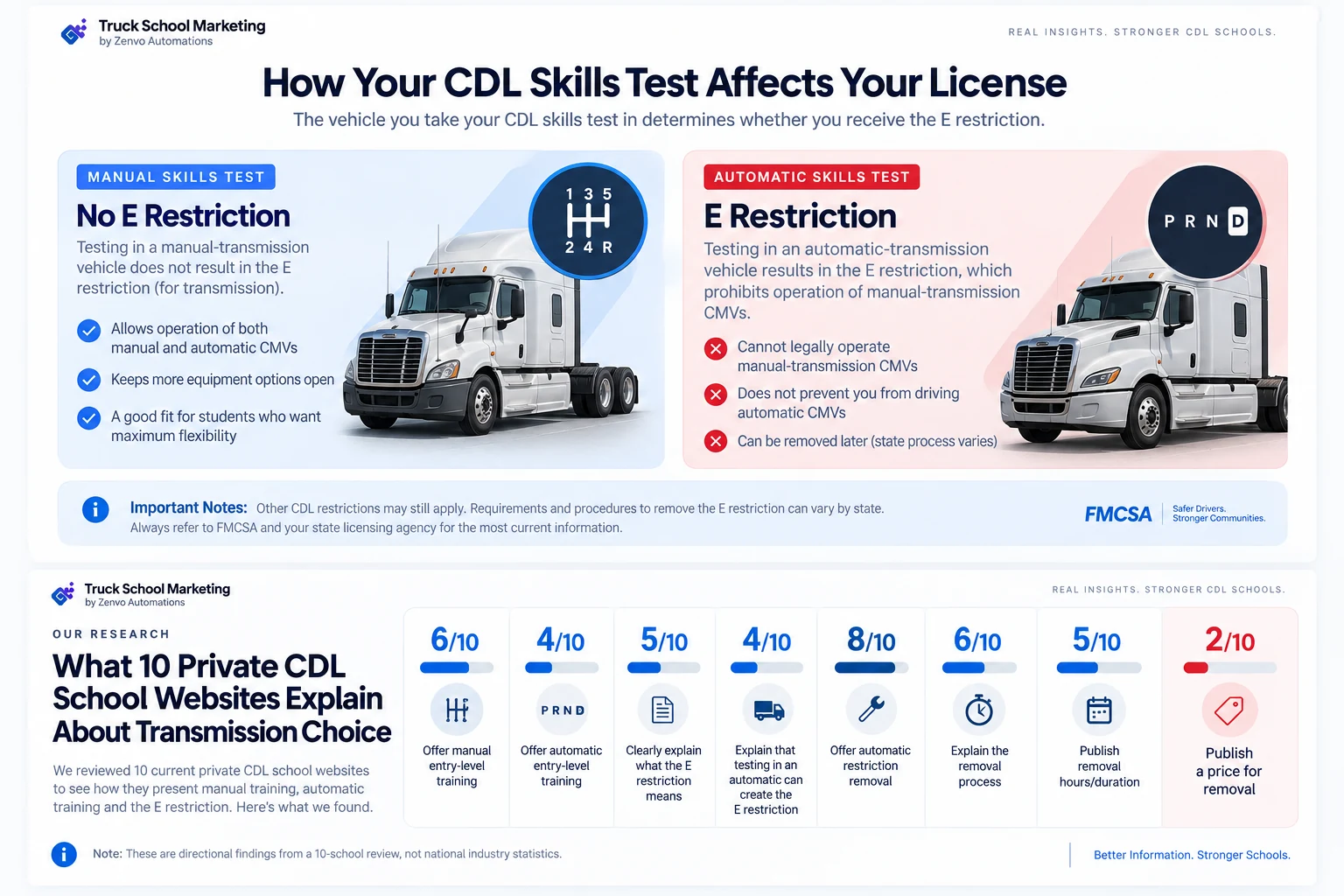
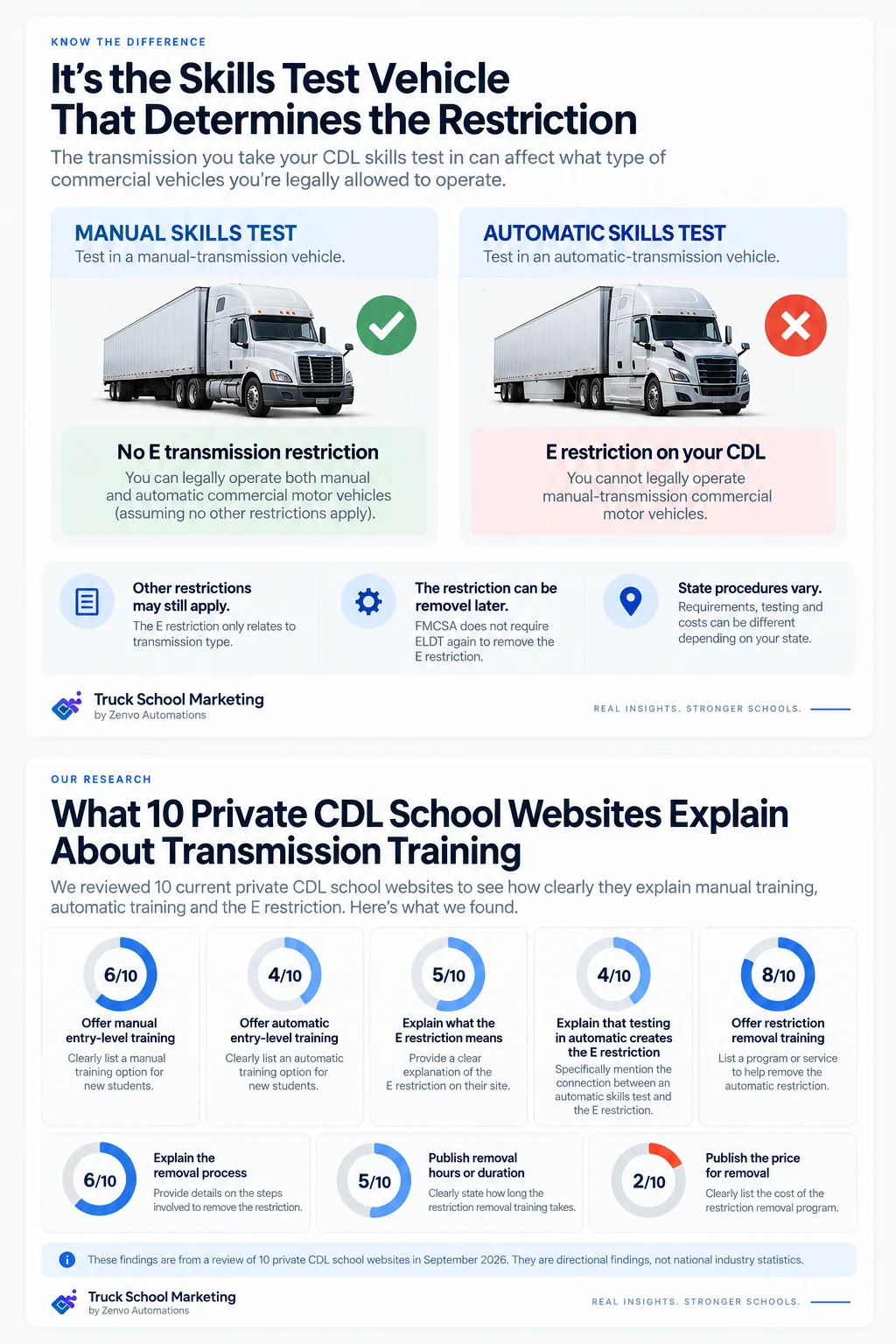
If a driver takes the CDL skills test in a vehicle with an automatic transmission, the CDL receives an E restriction. That restriction prevents the driver from legally operating a commercial motor vehicle with a manual transmission.
That is an important distinction because students often focus on what they will train in, when the vehicle used for the skills test is what determines whether the transmission restriction is placed on the license.
A school should be able to answer three basic questions clearly:
- What transmission will the student train in?
- What transmission will the student test in?
- What will that mean for the CDL they receive?
Those questions sound simple, but current student discussions show that plenty of people reach CDL school without understanding the difference. It is the same pattern we saw when looking at what students actually want explained before enrollment.
What the E Restriction Actually Means
The E restriction tends to get talked about in extremes.
One side makes it sound like an automatic restriction will destroy a driver’s career.
The other side dismisses it because many fleets operate automatic or automated equipment.
Neither explanation is especially useful to a prospective student.
The practical answer is simpler:
It does not prevent the driver from operating qualifying automatic-transmission CMVs.
And it does not automatically mean the graduate will have trouble finding work.
There are, however, still employers and specific driving jobs that require drivers without an automatic-only restriction. That means manual testing can preserve access to equipment and positions that would otherwise be unavailable.
That is the distinction schools should make.
Not:
Manual drivers make more money.
Not:
Nobody will hire you with an automatic restriction.
A more accurate explanation is:
Testing in a manual-transmission vehicle can preserve more equipment options because the license will not carry the E transmission restriction.
That gives the student useful information without overselling the outcome.
Automatic Training Can Still Be the Right Choice
There are legitimate reasons a student may choose automatic training.
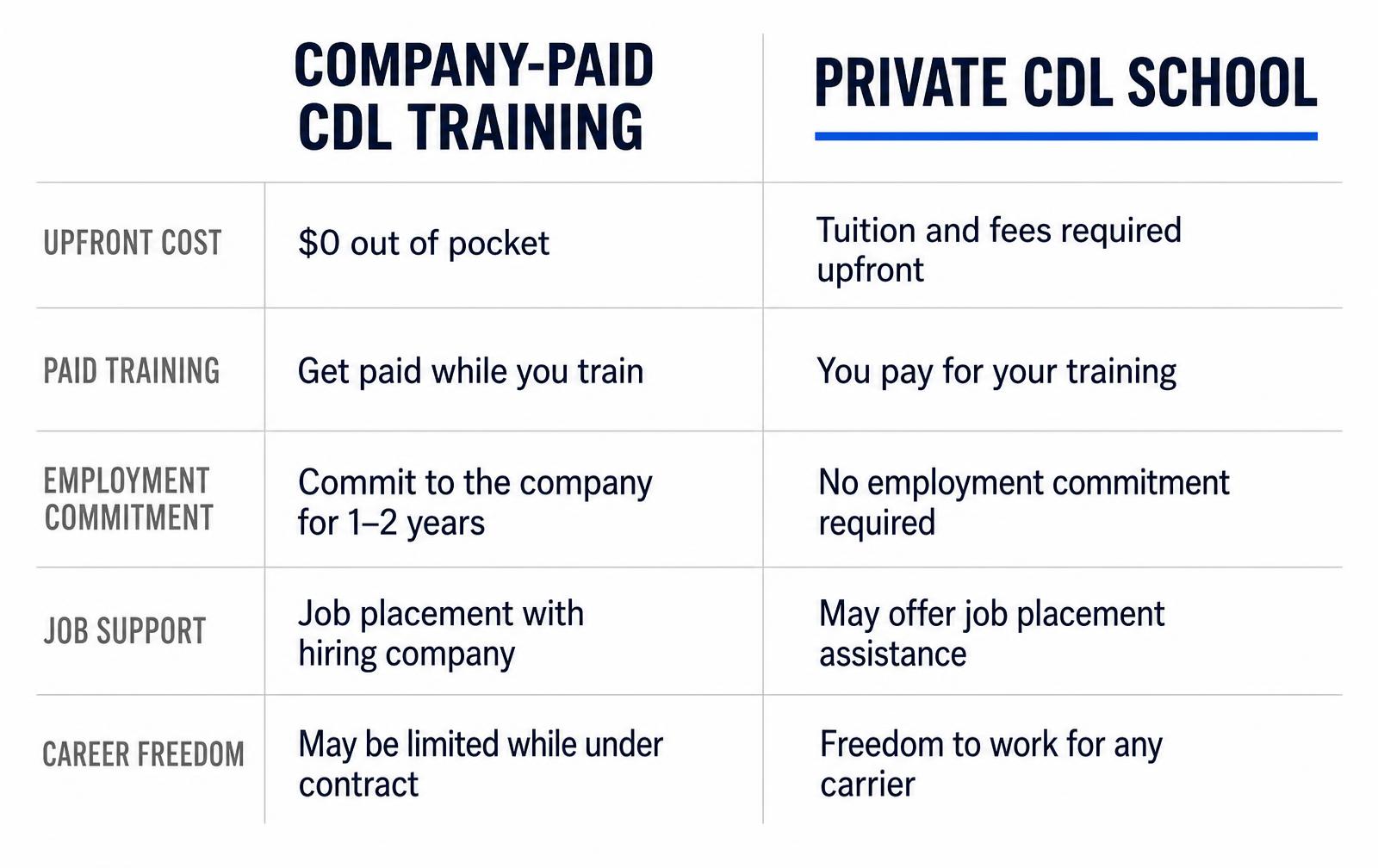
They may already have an employer lined up that operates automatic equipment — a situation that also comes up when students weigh company-paid CDL training against a private school.
They may be more comfortable learning vehicle control, backing and road skills without also learning to shift.
Or they may begin in manual training and discover that shifting is taking so much of their attention that it is interfering with the rest of their driving.
Recent CDL discussions show that this happens in real training environments. Students describe beginning in manual equipment and later switching to automatic when they cannot become comfortable enough with shifting during the available training period.
That does not have to be treated as failure.
Sometimes switching to automatic may be the most reasonable training decision for that student.
The important part is what happens before the switch is finalized.
Those are enrollment-process questions, not marketing slogans.
The Website Does Not Need to Carry the Entire Disclosure
There is a temptation to turn every transparency issue into another paragraph on the website.
I don’t think that is necessary here.
The website should accurately represent what the school offers.
If a Class A program is automatic-only, a prospect should be able to tell that.
If both manual and automatic training are offered, the school should make that distinction clear.
If the programs have different tuition, hours or requirements, those differences may also be useful to publish.
But a program page does not need to become a legal agreement.
The detailed acknowledgment belongs in the enrollment process.
Step 1
Website
Describes the program.
Step 2
Admissions
Explains the decision.
Step 3
Enrollment paperwork
Documents the decision.
That is a much stronger process than trying to make the website do all three jobs.
What the Enrollment Documentation Should Cover
Before the student enrolls, the school’s paperwork should make the selected training path clear.
Depending on the school and state requirements, that may be handled in the enrollment agreement itself or through a separate program acknowledgment.
- Student’s selected program
- Whether training is manual, automatic or a combination
- Expected transmission used for the CDL skills test
- Plain-English explanation of the E restriction when automatic testing is expected
- Any tuition or scheduling differences between the options
- School policy if the student changes transmission paths during training
The point is not to create another five pages of legal language.
It is to document a meaningful decision.
The student should not be able to finish training and reasonably say:
Nobody told me my license would have that restriction.
And the school should not have to rely on someone’s memory of an enrollment conversation months later.
Schools should have their own attorney or compliance professional review enrollment contracts and required state disclosures.
If the Student Switches From Manual to Automatic, Document That Too
This is probably the area where schools have the biggest operational opportunity.
Imagine a student begins a Class A manual program.
Two weeks later, the instructor and student agree that continuing in manual equipment is slowing the student’s progress. The student switches to automatic and ultimately takes the CDL skills test in an automatic truck.
That is not just an equipment change.
It changes the expected licensing outcome.
Example Document
Example: Program Change Acknowledgment
- Original program
- Class A Manual
- New program
- Class A Automatic
- Effective date
- Reason for change
- Student request / instructor recommendation / other
- Tuition impact
- Schedule impact
- Expected skills-test vehicle
- Automatic
- Student acknowledgment of E restriction
- Yes
- Student signature
- School representative
This does not need to be complicated.
It simply makes the decision visible.
For schools using a CRM or digital enrollment system, the same change should also update the student’s record so admissions, instructors and testing staff are all working from the same information. Clear program details like this are part of how private CDL schools turn inquiries into class starts.
Students Are Already Trying to Figure This Out on Their Own
Recent CDL discussions repeatedly come back to the same questions.
Prospective students ask whether an automatic-only course will hurt their career.
Others are trying to decide whether paying more for manual training is worth it.
Current students ask whether they should switch to automatic after struggling with shifting.
Graduates with an E restriction ask where they can find a manual truck, how much training they need, what testing must be repeated and how much restriction removal will cost.
The answers they receive online are often contradictory.
That does not mean Reddit or a trucking forum should determine school policy.
It means schools are dealing with a decision that students clearly do not understand very well.
The school has an opportunity to remove that uncertainty before it becomes a complaint, refund dispute or surprise after testing.
Removing the Automatic Restriction Later
An E restriction can be removed.
One important federal distinction is often misunderstood: FMCSA’s Training Provider Registry guidance states that removing the E restriction is not subject to the federal Entry-Level Driver Training requirements again.
That does not mean there is no process involved.
Drivers may still need manual-transmission training, access to the appropriate vehicle, state paperwork and another skills-testing process.
And those requirements can vary by state.
For example, state procedures differ, which is why a school should be careful about presenting one state’s restriction-removal process as though it applies everywhere.
For schools that offer restriction removal, there is also a legitimate service opportunity here.
A good restriction-removal program should clearly explain:
- Who the program is for
- How much manual training is included
- What vehicle is provided
- What testing is required in that state
- Whether the school provides the testing vehicle
- How long the process usually takes
- School fees
- Separate testing or state fees
- What the student needs to complete before arriving
That information is far more useful than a page that simply says:
Call us to remove your automatic restriction.
What We Found Reviewing 10 Private CDL School Websites
As part of our September 2026 research, we reviewed ten current private CDL school websites to see how they handled automatic training, manual training and E-restriction removal.
The results showed a noticeable gap between offering the service and explaining the service.
Truck School Marketing Research
How 10 Private CDL School Websites Explain Transmission Training
- Clearly offered manual entry-level training6/10
- Clearly offered automatic entry-level training4/10
- Clearly explained what the E restriction means5/10
- Explained that testing in an automatic creates the restriction4/10
- Clearly offered restriction-removal training8/10
- Clearly explained the removal process6/10
- Published removal hours or duration5/10
- Clearly published the restriction-removal price2/10
These are directional findings from a ten-school review conducted in September 2026, not national industry statistics.
Still, the pattern is interesting.
That suggests there is still a lot of room for schools to make this process easier to understand.
Schools Reviewed
The review looked at the public websites of the following private CDL schools in September 2026. Findings are reported in aggregate only, and no school is scored individually.
- Lone Star Truck Driving Academy — Texas
- Western Truck School — California
- 1st Class CDL Truck Training — Florida
- SunState CDL — Florida
- Hamrick School — Ohio
- Napier Truck Driver Training — Ohio
- Katlaw Truck Driving School — Georgia
- On Point Trucking Academy — North Carolina
- Bestway Driving Academy — Indiana
- Safety First Trucking Academy — Texas
The Best Process Keeps Everyone Telling the Same Story
The strongest approach is not complicated.
- Website
- Admissions
- Enrollment Agreement
- Training Team
- Skills Test
- The website accurately describes the program.
- Admissions explains the transmission choice.
- The enrollment agreement documents the student’s selection.
- The instructor understands what the student enrolled in.
- If the training path changes, a change acknowledgment documents the new decision.
- And the student reaches test day knowing what vehicle they are testing in and what that means for their license.
That consistency matters.
Problems tend to appear when the website says one thing, admissions says another, the training department assumes something different, and the paperwork does not clearly document any of it.
A good enrollment process removes those gaps.
The Goal Is Informed Choice, Not Pushing One Transmission
Automatic vs. manual CDL training does not need to become an argument over which kind of truck is better.
Both paths can make sense.
A student who already knows they are going to an automatic fleet may make a different decision than a student who has no employer lined up and wants to preserve as many equipment options as possible.
A student who is struggling to safely manage a manual transmission may make a different decision than someone who already knows how to shift.
The school’s job is not necessarily to make that choice for them.
The school’s job is to make sure the student understands what they are choosing.
Before enrollment, the student should know which program they are entering.
Before the CDL skills test, they should know what vehicle they are expected to test in.
If they switch from manual to automatic, they should understand what changes.
And the school should have documentation showing that the decision was explained.
The Takeaway
The worst time for a student to learn what the CDL E restriction means is after the new license is already in their hand.
Explain the transmission decision before enrollment, and document it in the paperwork the student actually signs.
Sources and Further Reading
FMCSA
Commercial Driver's License — driver information and restrictionsFMCSA Training Provider Registry
Driver FAQ — restriction removal and ELDT applicabilityIllinois Secretary of State
Commercial Driver's License informationMinnesota Department of Public Safety
CDL Endorsements and Restrictions
Restriction-removal procedures, testing requirements and fees vary by state. Students and schools should confirm current requirements with the appropriate state licensing agency.