Enrollment & Admissions
The Student Said Yes. Then They Never Made It to Class.
Private CDL schools put a lot of effort into generating leads. But some of the most important enrollment losses happen later — after a prospect is serious, but before they ever reach day one.
Original Research
Research-based editorial drawing on three directional reviews of ten private CDL-school websites conducted September 13, 15 and 16, 2026.
A prospective student can want a CDL badly enough to fill out a form, take your call, tour the school and start figuring out how to pay for training.
And still never make it to class.
Anyone who has worked around CDL enrollment long enough has seen it.
The prospect seemed solid.
Then funding took longer than expected.
Or a driving-history question came up.
Or the student needed local work and began wondering whether the jobs would actually fit.
Or the next class was several weeks away.
Or nobody was quite sure what still needed to be completed before the start date.
Eventually, the student stopped answering.
It is tempting to call that a bad lead.
Sometimes it is.
But sometimes the school lost a perfectly legitimate student somewhere in what I think of as the missing middle of CDL enrollment — the stretch between serious interest and actually showing up for class.
That stretch deserves more attention.
Enrollment path
THE MISSING MIDDLE OF CDL ENROLLMENT
- 01
Serious Prospect
- 02
Job Fit
- 03
Funding
- 04
Class Date
- 05
Day One
The Lead Is Only the Beginning
Most serious CDL prospects eventually have to answer three questions.
Can this training realistically lead to the kind of job I want?
How am I going to pay for it?
When can I actually start?
Those questions look separate on a website.
In real enrollment conversations, they rarely are.
A 20-year-old student who needs local work has a different decision in front of them than a 35-year-old who is open to regional or OTR work.
A prospect waiting on WIOA funding has a different timeline than someone paying cash.
A working parent considering evening classes needs to know more than whether the school technically offers a night program.
And a student with a pre-hire letter may feel much more secure about training than someone who has no idea who might hire them afterward.
If any one of these questions stays unresolved for too long, the entire enrollment can stall.
“Can I Get a CDL?” Is Usually a Bigger Question
Prospects ask simple questions that often mean something larger.
“Can I get a CDL?”
On the surface, that sounds like a licensing question.
But a lot of the time what they are really asking is:
If I spend the money and finish this program, can I actually make a living doing this?
That distinction matters.
A person can qualify for CDL training and still have fewer employment options than they expected.
Age can affect the immediate job market.
Driving history can matter.
Medical qualification matters.
Clearinghouse status can matter.
Endorsements and license restrictions can matter.
Experience requirements can matter.
And the kind of driving the student wants matters considerably.
Someone who tells admissions, “I have to be home every night,” is not giving the school a minor preference.
That may be one of the biggest factors in whether training makes sense for them right now.
The same principle applies to equipment.
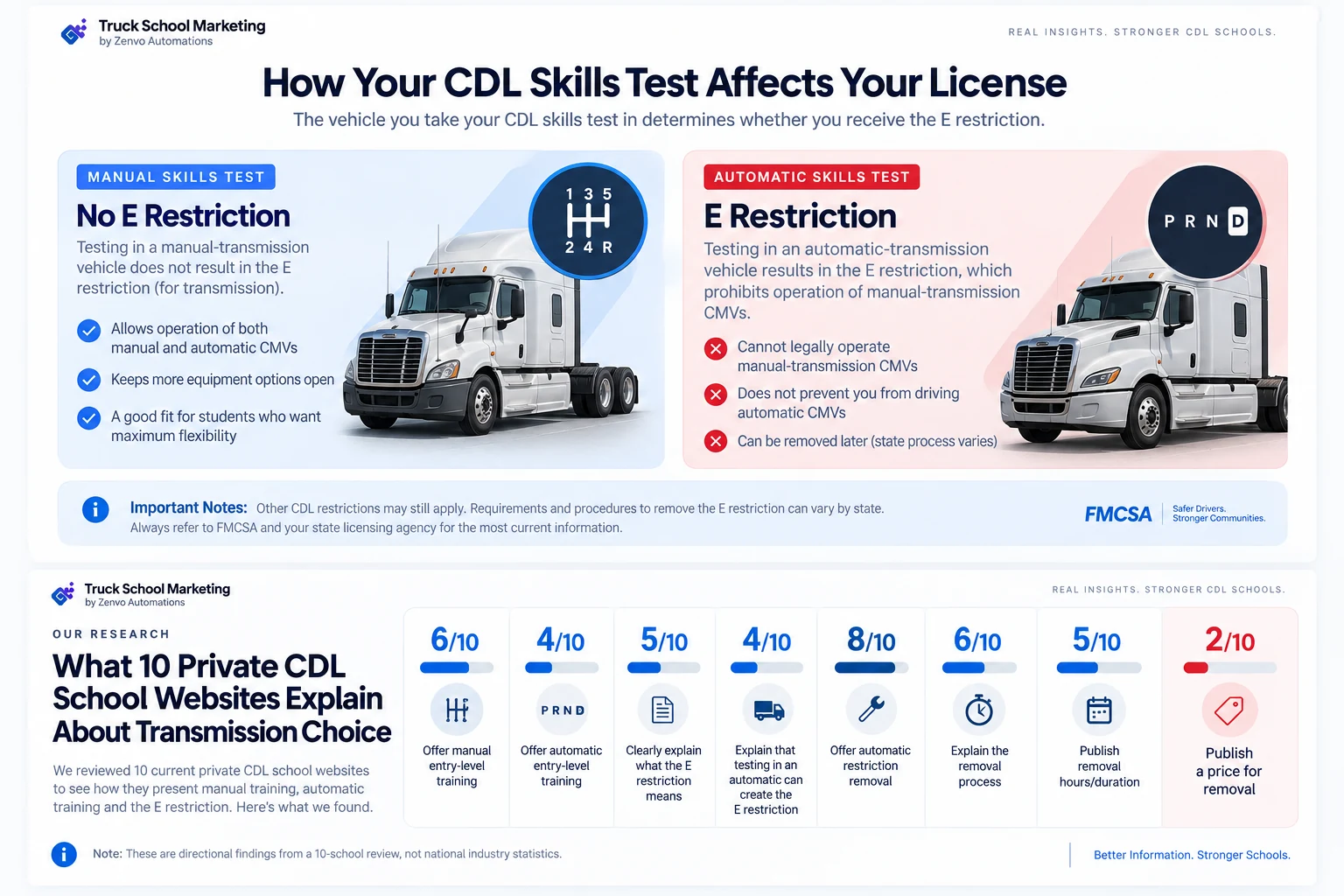
Our earlier research into automatic versus manual CDL training found that schools do not always explain the employment implications of the E restriction as clearly as they could.
None of this means a CDL school should try to act like a carrier's hiring department.
It shouldn't.
The school does not control every employer's standards, and one carrier's requirements should never be presented as an industry-wide rule.
But there is a big difference between predicting whether someone will get hired and identifying an obvious expectation problem before tuition changes hands.
In our September 13 directional review of ten private CDL-school websites, only four clearly distinguished school or CDL eligibility from employer hiring criteria.
Only three clearly described a pre-enrollment employability or carrier-screening process.
That is where misunderstanding can begin.
A prospect hears:
“You qualify for our program.”
What they may remember is:
“I'm qualified for the career I want.”
Those are not the same thing.
A Pre-Hire Helps. It Does Not Mean the Process Is Finished.
Pre-hire letters are useful partly because they reduce some of that uncertainty.
A carrier has reviewed information about the student and sees a potential fit.
For some students, that can also help with school funding.
But a normal pre-hire should not be confused with a finished hiring process.
Motor carriers still have their own qualification requirements. Federal rules also require employers to conduct Clearinghouse queries as part of pre-employment driver investigations.
That means a student may still have steps involving driving records, background information, drug testing, orientation, current openings and the employer's final qualification process.
Yet in our separate ten-school review of pre-hire information, only two schools clearly defined a pre-hire in plain English.
Only three clearly explained the conditional or non-guaranteed nature of that stage.
There is no reason to make this complicated.
A school can simply explain:
A pre-hire means a carrier currently sees you as a potential fit based on the information available. Final employment still depends on completing the carrier's hiring and qualification process.
That does not make a pre-hire less valuable.
It makes the school's explanation more credible.
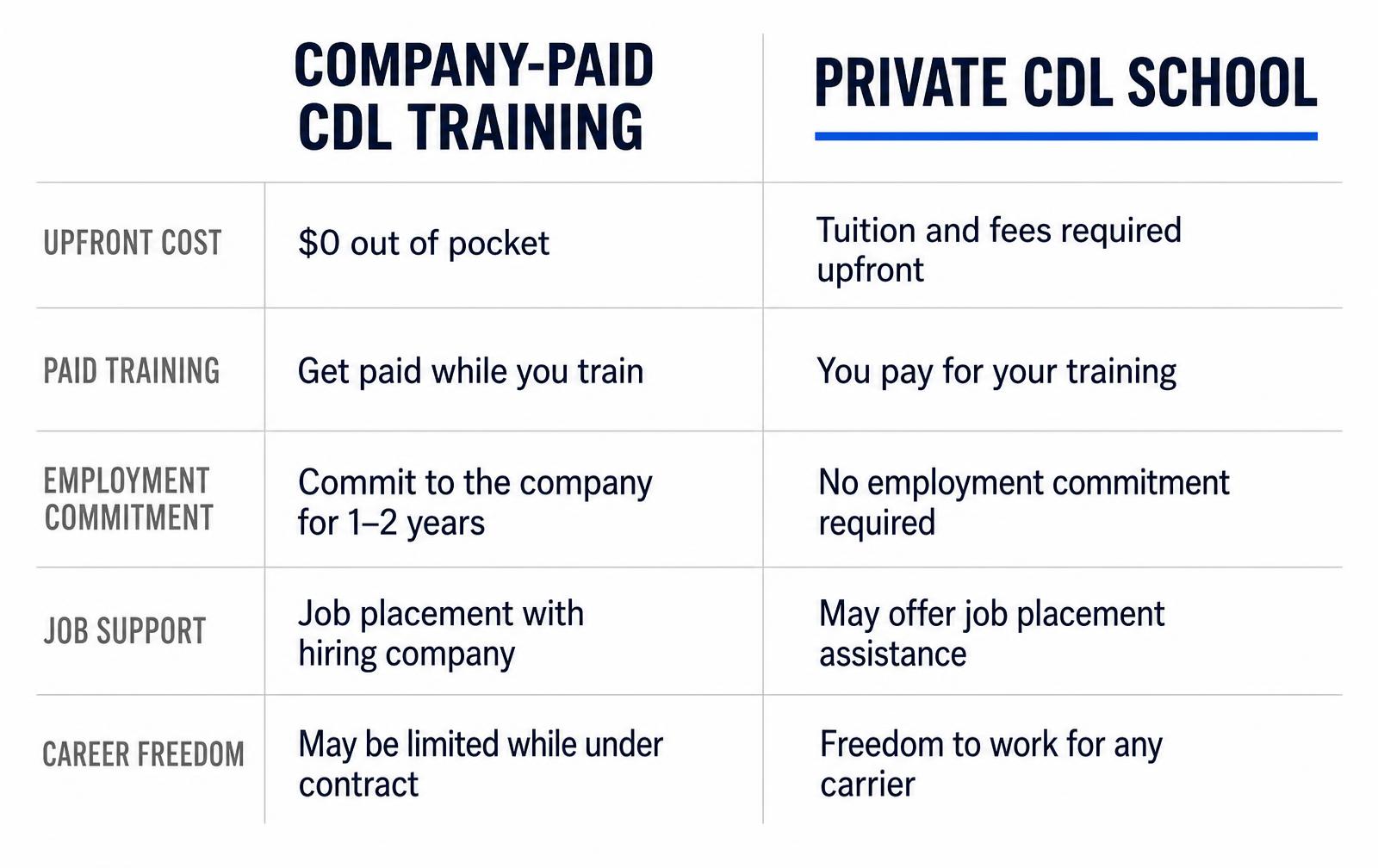
It also gets at one of the reasons company-paid CDL training can look so appealing to prospects.
Carrier programs often present a very visible path from training to employment.
Private schools do not need to imitate that model.
But they do need to make their own path easy to understand.
Growth Center Research
Where CDL School Websites Leave Prospects Guessing
- Specific upcoming class date5/10
- Employer criteria vs. school eligibility4/10
- Pre-start process explained4/10
- Funding process clearly explained4/10
- Pre-enrollment employability screen3/10
- Funding decision-maker identified3/10
- Funding-delay guidance3/10
These are directional findings from three separate 10-site website reviews, not national industry percentages.
Funding Can Put a Good Prospect Into Limbo
The second major point of friction is money.
WIOA is a good example because it can turn a highly motivated student into what looks like an inactive lead.
A prospect may have decided on the school.
They may be ready to train.
But there is another process happening outside the admissions department.
Workforce intake.
Eligibility review.
Documents.
Counselor communication.
Program approval.
An Individual Training Account or other authorization.
Then coordination with the school's actual class schedule.
WIOA operates through state and local workforce systems, and eligible-provider and program requirements matter for training funded through that system.
The CDL school can help.
It cannot simply approve the student itself.
That sounds obvious to someone who works with these programs every day.
It is not always obvious to the person trying to get their CDL.
Our September 15 review showed that nine of ten school funding pages mentioned WIOA or workforce funding.
Only three clearly identified the workforce system as the party making the eligibility decision.
Only four gave prospects a clear process to follow.
That is the difference between saying:
“WIOA funding available.”
and answering the question the prospect actually has:
“What am I supposed to do next?”
WHO CONTROLS WHAT IN THE FUNDING PROCESS?
The school can help with
- Explaining available funding paths
- Providing program and tuition information
- Supplying required school documents
- Coordinating with the workforce office
- Identifying target class dates
- Helping the student prepare while approval is pending
- Offering alternative payment paths when appropriate
The workforce system controls
- Individual eligibility
- Required intake and documentation
- Funding availability
- Training-plan approval
- ITA/voucher authorization
- Local program rules
- Approval timing
The same caution now applies to Workforce Pell.
Workforce Pell became effective July 1, 2026, but eligibility attaches to approved workforce programs. Institutions have to go through the applicable state and federal approval process; the existence of Workforce Pell does not automatically make every CDL program Pell-eligible.
For a school owner, the larger lesson is not just about compliance language.
It is about enrollment.
“I applied for WIOA” isn't really a status.
Did they submit an online inquiry?
Did they complete workforce intake?
Do they have a counselor?
Are documents missing?
Has their training plan been approved?
Has funding actually been authorized?
Those are completely different stages.
If the CRM treats all of them as WIOA Pending, the school has very little idea what should happen next.
Then Comes the Question That Sounds Almost Too Simple
“When can I start?”
That may be one of the most important questions in the entire enrollment process.
A prospect can be qualified.
Their funding can be lined up.
Their family can be on board.
They can be completely ready to change careers.
But if they do not know when training begins, momentum starts to disappear.
Every additional week between a student's decision and the actual class start creates another chance for something to change.
Work gets busy.
Childcare changes.
A vehicle breaks down.
Another school offers an earlier class.
A carrier program starts looking easier.
The student rethinks the money.
Or life simply gets in the way.
This is why “classes starting soon” is weak enrollment information.
In our September 16 review of ten private CDL-school websites, eight explained some kind of recurring or dated class-start cadence.
Only five published a specific upcoming start date.
Only four clearly explained what happens before the student's first day.
And only three gave meaningful guidance to someone whose funding or approval was delayed.
The stronger approach is concrete:
Next weekday Class A start: October 5.
Next evening class: October 19.
Waiting on funding? We can help you target the next available class while your authorization is completed.
Now the prospect can plan.
That is especially important for working adults.
“Night classes available” sounds straightforward.
But if the program also requires a week of daytime classroom instruction or daytime testing, that can completely change whether the schedule works.
It is better to find that out before enrollment than after it.
Federal Requirements Create Their Own Timeline, Too
Schools also have to distinguish their class calendar from the licensing timeline.
FMCSA's current guidance says first-time Class A and Class B applicants subject to ELDT must complete training through a registered provider before testing, and a CLP must currently be held for at least 14 days before the CDL skills test. States can add requirements of their own.
That makes several dates worth separating:
- Class starts.
- ELDT is completed.
- The student becomes eligible for the skills test.
- The student actually tests.
- The CDL is issued.
To someone inside the industry, those are obviously different milestones.
To a first-time student, they can easily blur together.
Good enrollment communication makes the sequence visible.
More Follow-Up Is Not Always the Answer
A lot of enrollment problems get diagnosed as follow-up problems.
Sometimes they are really clarity problems.
Sending another text does not solve the fact that the prospect still does not understand whether workforce funding will cover the program.
Calling again does not answer whether the local jobs they want commonly hire brand-new graduates.
An automated reminder does not fix a website that says only “classes start regularly.”
The best follow-up moves the prospect through an actual process.
FROM ‘YES’ TO DAY ONE
- Qualified
- Job Fit Discussed
- Funding / Payment Path
- Class Selected
- Seat Reserved
- Permit + Documents
- 7-Day Check
- 48-Hour Confirmation
- DAY ONE
Funding delayed
- 01Move to next viable cohort
- 02Review alternate funding path
- 03Continue stage-specific follow-up
Student not ready
- 01Finish prerequisite
- 02Assign new target start date
- 03Resume pre-start sequence
Not everybody belongs in the same sequence.
A student waiting on WIOA authorization needs different communication from a self-pay student who simply has not completed the permit.
A prospect with a pre-hire needs different follow-up from someone who has not spoken with a carrier.
And someone starting class in two days should not still be getting messages asking whether they are interested in CDL training.
By then, the conversation should have changed.
Do you know where to go?
What time are you arriving?
Do you have the documents?
Is your transportation handled?
Has anything changed that could keep you from starting?
The closer the student gets to class, the less useful persuasion becomes. Logistics becomes more important.
That is where a well-designed CDL recruiting and automation process can help — not because automation itself is impressive, but because the system knows what the student is waiting on.
A School's Website, Admissions Team and CRM Should Agree
This is ultimately one system.
The CDL school website should answer the universal questions before the student ever submits a form.
What does the program cost?
What funding paths exist?
When do classes start?
What schedule is actually required?
What does job-placement help mean?
What requirements should the student know about?
Admissions should then handle the questions that require a real conversation.
Does the student's career goal fit?
Are there obvious employment concerns worth discussing?
Which funding path are they pursuing?
Which class are they trying to enter?
What still has to happen before that date?
The CRM should preserve those answers so the student does not have to start the conversation from zero every time someone at the school calls.
This is the same principle behind good training transparency, and it is the final stage of the CDL school marketing and enrollment playbook.
Our earlier research found that terms such as “160-hour program” and “hands-on training” are far less useful when the prospect cannot understand the actual wheel time, truck access, retesting process or training experience behind them.
Enrollment language works the same way.
Specific beats vague.
One Number I Would Watch More Closely
Most CDL schools know how many leads they receive.
Many know how many tours they schedule.
Most know how many students enroll.
I would also watch the gap between:
Students who appear committed or approved
and
students who actually start class.
If 20 people look enrolled and 14 arrive on day one, the other six deserve more than a generic Lost status.
What happened?
Was funding delayed?
Did the student move to another cohort?
Was there a permit problem?
Did the schedule no longer work?
Did they choose another school?
Did they switch to company-paid training?
Was there a job-fit issue?
Did they simply stop responding?
The point is not to pressure people harder.
It is to find out where the enrollment process is leaking.
Because a student who fails to start is not automatically a marketing problem.
It could be a funding problem.
A schedule problem.
A career-expectation problem.
A communication problem.
Or a process problem.
Those problems look identical if the only status in the CRM is Lost Lead.
The Real Job Is Getting From “Yes” to Day One
Private CDL schools put real effort into generating interest.
That is necessary.
But once a good prospect says yes, the work is not finished.
In some ways, that is where the most important part begins.
The student still needs a path they can see.
Can this training realistically lead somewhere I want to go?
How am I paying for it?
When am I starting?
What has to happen between now and then?
A school that answers those questions clearly does more than improve its marketing.
It makes enrollment easier to navigate.
Admissions knows what to follow up on.
The student knows what they are waiting for.
The CRM reflects what is actually happening.
And fewer good prospects spend weeks sitting somewhere between “I'm ready” and day one with no clear idea what comes next.
Browse more research and practical guidance in the CDL School Growth Center.