Enrollment & Admissions
CDL Admissions Checklist: What Private Schools Should Collect Before Day One
A practical admissions checklist for private CDL schools: what to explain, collect and track for licenses, identity, MVRs, medical cards, drug testing, permits, funding and day-one readiness.
Original Research
We reviewed the public admissions and enrollment paths of 10 private CDL schools in September 2026. The findings below describe that reviewed sample, not the industry as a whole.
A CDL applicant can fill out an application, get accepted and still be nowhere near ready for class.
That is where a lot of admissions processes become messy.
A driver’s license, DOT physical, permit, funding approval, driving record and enrollment agreement are not all the same kind of requirement — and they are not all due at the same time.
Some come from federal driver or CDL rules. Some depend on the state licensing agency. Some are school admission policies. Others come from a workforce program, financing provider or prospective employer.
Then there are the school’s own readiness requirements: the steps that must be finished for a student to take the seat they were promised and arrive prepared on day one.
When all of those items get flattened into one admissions checklist, the website becomes vague and the CRM becomes nearly useless.
The better approach is to explain the process clearly to the student, then track every hard requirement separately behind the scenes.
Growth Center Research
What 10 Private CDL School Admissions Pages Explain Before Enrollment
CDL Admissions Gets Confusing When Every Requirement Gets Put in One Bucket
“DOT requirement” is often used as shorthand for almost anything that appears on a CDL school checklist.
That can be misleading.
A federal rule may govern what a driver needs to operate in interstate commerce. A state driver licensing agency may control what documents are accepted for a permit. A school may require a drug screen before training. An employer may have its own hiring standards. A workforce office may need documents before authorizing funding.
Those requirements can all matter. They simply do not come from the same source.
That distinction should be visible in the admissions process:
Five Requirement Types to Track Separately
- Federal driver and CDL requirements
- State licensing and document requirements
- School admission policies
- Funding or employer requirements
- Internal enrollment and start-date readiness requirements
Labeling the source of a requirement helps the student understand why it exists and helps staff avoid presenting a school policy as federal law.
Start With Basic CDL Eligibility
The first screen should answer whether the prospect appears able to enter the licensing and training path the school offers.
Age is one example. Federal rules allow a commercial learner’s permit starting at 18, but interstate commercial driving generally requires the driver to be at least 21. A younger applicant may still have an intrastate path, subject to the laws and opportunities in that state.
That is not the same as saying every 18-year-old has the same post-graduation job options as a 21-year-old.
The school should also confirm that the applicant has the kind of valid non-commercial driver’s license required by the issuing state and identify the correct state-specific rules for identity, lawful presence, residency or domicile.
FMCSA maintains links to each state driver licensing agency. Schools should send students to the authority for the state where they will apply rather than pretending one nationwide document list works everywhere.
The website can explain the broad path. The current state authority should remain the source of truth for accepted documents, fees, testing and issuance procedures.
Build a Real Document Checklist
“Bring required documents” is not a useful instruction.
A real checklist tells the student what is needed, when it is due, whether an original or copy is acceptable, who verifies it and what happens if it is missing.
Identity and legal presence
State licensing agencies may require specific proof of identity and lawful status. The accepted combinations can differ, so the school should link to the current state list and avoid paraphrasing it so loosely that the student arrives with the wrong paperwork.
Residency or domicile
Students may need evidence connecting them to the licensing state. Admissions should explain whether the school needs a copy for its own file, whether the state needs the original, and whether an address mismatch needs to be resolved before the permit appointment.
Social Security documentation
If a Social Security number or document is part of the school’s or state’s process, say exactly what is accepted. “SSN documentation” should not force a student to guess whether a card, verified number or another record is required.
Education documents when required
A diploma, transcript, GED record or entrance assessment may be a school, state approval, accreditation, funding or program requirement. Name the source and timing instead of implying that every CDL applicant nationwide faces the same education rule.
Other school-specific documents
Enrollment agreements, payment authorizations, handbook acknowledgments and releases belong on the checklist too. They should be separated from licensing documents so the student and admissions team can see which party is waiting on what.
Every Document Request Should Answer Five Questions
- What exactly is required?
- When is it due?
- Is an original, certified copy or ordinary copy needed?
- Who verifies and records it?
- What happens when it is missing or rejected?
Review the Driving Record Before the Student Pays Thousands
Only four of the 10 admissions paths in our directional audit clearly explained driving-record or MVR eligibility.
That is a meaningful gap because three separate questions can get confused:
- Can the person satisfy the state’s licensing requirements?
- Does the person meet the school’s admission policy?
- How might the record affect the employers or job types the student is targeting?
Those are not interchangeable. One carrier’s hiring rule does not represent the entire trucking industry, and a school should not promise employment based on a quick record review.
But obvious barriers should be discussed before a student pays thousands of dollars whenever reasonably possible.
Admission to training and qualification for a particular driving job are two different decisions.
A practical screen can identify unresolved suspensions, recent serious violations, an incorrect license status or a mismatch between the student’s record and the kind of work they expect after training. When the answer is unclear, the right next step is a real admissions review — not a sales message telling the prospect to hurry and reserve a seat.
Treat Medical Readiness as a Milestone, Not a Checkbox
All 10 schools in our reviewed sample mentioned a DOT physical. That does not mean every page explained what happens after the exam.
For interstate commercial driving subject to the federal physical-qualification rules, the medical exam is performed by an examiner listed on the National Registry of Certified Medical Examiners. CDL holders and applicants also interact with their state licensing agency regarding medical self-certification and record status.
Operationally, “DOT physical completed” and “student is fully ready for the next licensing or training step” may not be the same status.
An exam can lead to a certificate, a time-limited certificate, a need for additional documentation or a problem that requires follow-up. The admissions team needs to know which one occurred.
- Medical exam complete
- Medical certification verified
- Problem or exception recorded
- Next required action assigned
Explain Drug Testing and Clearinghouse Requirements Correctly
Six of the 10 reviewed admissions paths mentioned drug screening. The important question is how the school describes it.
Not every drug test administered or requested by a school is automatically a federally required DOT test.
Federal pre-employment controlled-substances testing under Part 382 applies to employers before a driver performs safety-sensitive work. Employers also have pre-employment and annual Clearinghouse query responsibilities.
A private school may separately require a test as school policy, a funding program may impose a condition, or an employer may require testing later in the hiring process.
Each can be legitimate. The page should identify which one it is.
Make Permit Timing Impossible to Misunderstand
Only three of the 10 reviewed admissions paths clearly explained when the commercial learner’s permit was due.
That leaves a prospect wondering whether the CLP is required before applying, before enrollment, before day one, during the first part of class or only before behind-the-wheel instruction.
The answer can depend on the program design and state process. FMCSA’s ELDT rules also require a training provider to verify that a student holds a valid CLP or CDL before behind-the-wheel training.
If permit preparation is included, say what is taught, when the student is expected to test and whether the state testing appointment is the student’s responsibility. If the permit must already be in hand, say that before the application is submitted.
The page should also explain the exception path:
- What happens if the student does not pass on schedule?
- Can they continue with theory instruction?
- Does their target cohort change?
- Who sets the new permit deadline?
Permit timing belongs in the admissions calendar, not in a surprise conversation after tuition has been arranged.
Funding Approval Is Not the Same as Admissions Completion
A student can receive WIOA authorization, financing approval, employer sponsorship or another funding commitment and still have unfinished admissions requirements.
They may still need a medical certificate, accepted identity documents, a permit milestone, an enrollment agreement or a confirmed class date.
Likewise, a school can accept a student while the outside funding decision remains pending. WIOA training support operates through state and local workforce systems, and eligible program information is maintained through those systems. The school can help the student move through the process, but it does not control the funding decision.
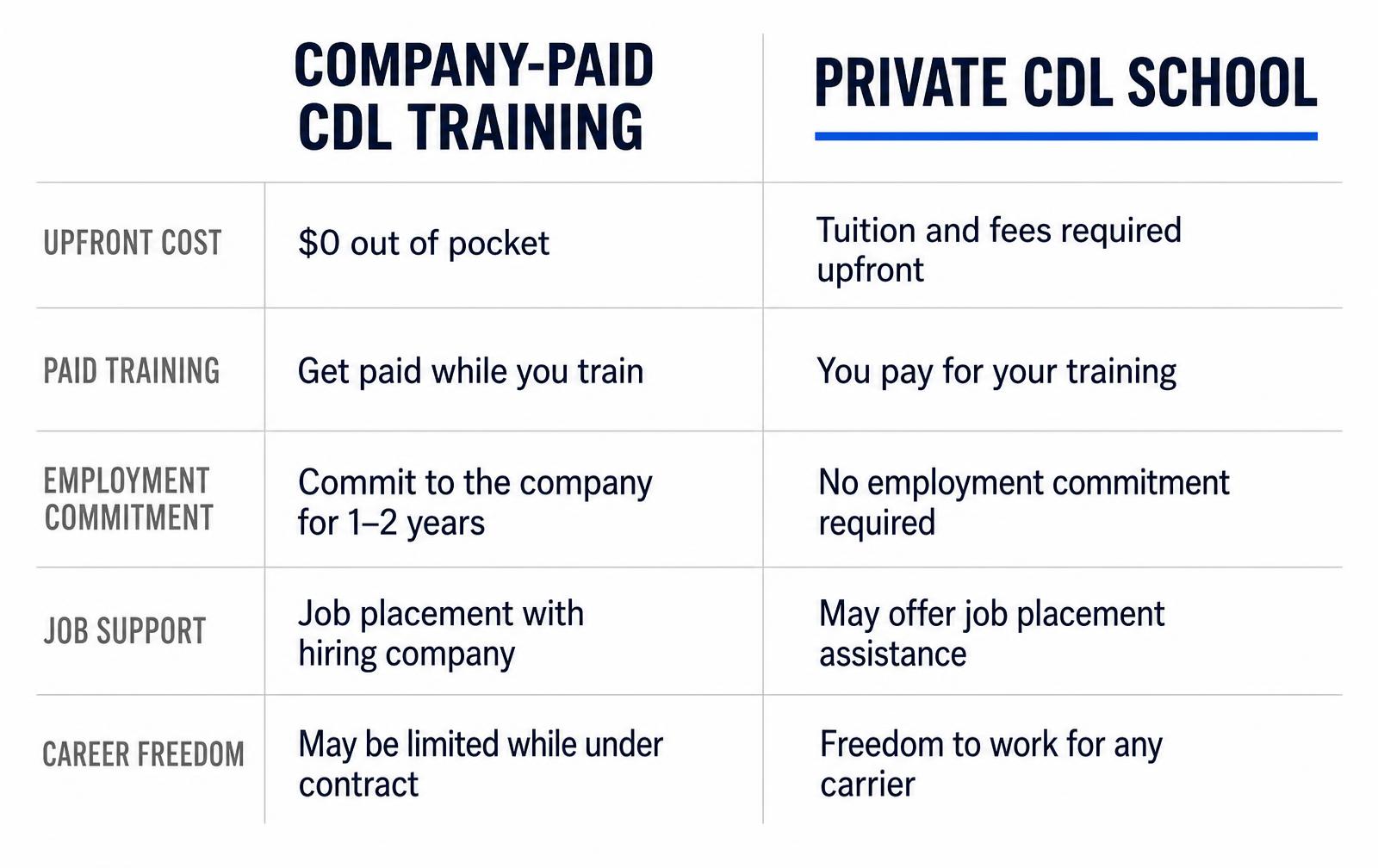
That distinction is covered in more depth in our article about why serious CDL prospects disappear before class starts. It is also part of the decision students make when comparing a private school with company-paid CDL training.
A good admissions system can show Funding Approved and Medical Pending at the same time. It should never force staff to choose one broad label that hides the other.
Turn the Admissions Checklist Into a Readiness Pipeline
The public-facing checklist explains the path. The internal pipeline shows whether the student has actually completed it.
Admissions operations / field map 01
From CDL Lead to Day-One Ready
11 readiness
checkpoints
Phase 1
Applicant Qualification
- 01
Lead
- 02
Basic Eligibility
- 03
ID / Residency
- 04
Driving Record
Phase 2
Admissions Completion
- 05
Medical
- 06
Drug / Clearinghouse When Applicable
- 07
CLP / Permit
- 08
Funding / Payment
- 09
Enrollment Agreement
Phase 3
Start Readiness
- 10
Start-Date Readiness
- 11
DAY ONE
Each major requirement should be a field or status that the admissions team can see, filter and act on.
Recommended Admissions CRM Fields
- Eligibility Status
- Driver License Verified
- Identity / Residency Verified
- SSN Documentation
- MVR Status
- Medical Exam Status
- Medical Certification Verified
- Drug / Clearinghouse Status
- CLP Status
- Funding Status
- Enrollment Agreement Status
- Target Start Date
- Day-One Ready
- Barrier / Exception Reason
- Next Action Date
The exact field names can vary. The important part is that the team can identify the unfinished requirement without opening notes and reconstructing the entire conversation.
This is where a well-built CDL recruiting and automation process earns its place. It should organize the work around the student’s actual stage, not simply send more messages.
What Happens When One Requirement Is Missing?
A real admissions problem should change the workflow.
Automation should not continue sending ordinary marketing messages after the system already knows that a hard requirement is overdue.
- Missing document → document request workflow
- MVR concern → admissions review
- Medical issue → human follow-up
- Permit delay → new permit milestone and date
- Funding delay → funding-pending workflow
- Work schedule conflict → alternative cohort or schedule
- Student cannot start → named next class instead of generic nurture
A requirement without a deadline is not operationally useful.
The same principle applies to the CDL school website. A student should be able to understand the broad sequence before calling, while the admissions team keeps the specific verification details and protected records in the appropriate internal system.
Clear admissions communication is part of broader training transparency. The school is not promising that every step will be easy. It is showing students what the steps actually are. Admissions sits inside the broader student recruitment and enrollment system a private school runs.
What This Means for Your School
The purpose is not to make the admissions page longer.
It is to make the process easier to understand and easier to operate.
A prospective student should know what the school needs, what the state needs, what an outside funding or employer process may need, and when each item becomes important.
The admissions team should be able to look at the same student and immediately see what is complete, what is blocked, who owns the next action and whether the target class date is still realistic.
That is the difference between publishing a list of requirements and running a readiness process.
Browse more operator-focused research in the CDL School Growth Center.